Wiki on Tang Dynasty
Knowledge Base on China Tang Dynasty
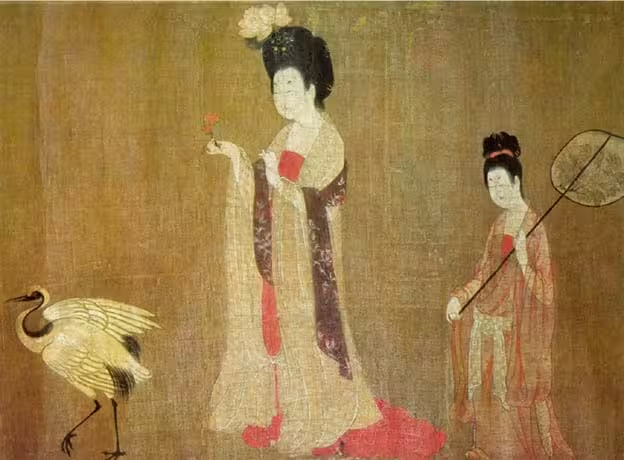
Chinese culture flourished and further matured during the Tang era. Historians generally regard the Tang as a high point in Chinese civilisation, and a golden age of cosmopolitan culture.
→ Li Jiancheng
Li Jiancheng (589 – 2 July 626), posthumously Crown Prince Yin, was the eldest son of Emperor Gaozu and the first heir apparent of the …
→ Li Jing
Li Jing (571 – 2 July 649), courtesy name Yaoshi, posthumously Duke Jingwu of Wei, was the Tang dynasty's supreme strategist — the …
→ Li Linfu
Li Linfu (died January 3, 753), Duke of Jin, was chancellor of the Tang empire for eighteen years (734–752) under Emperor Xuanzong — …
→ Li Yuanji
Li Yuanji (603 – 2 July 626), Prince of Qi, posthumously Prince La of Chao, was the fourth son of Emperor Gaozu and the imp of the …
→ Literature & Poetry
The Tang dynasty was, by the consensus of every subsequent age, the greatest era of Chinese poetry — and not by a small margin. Nearly …
→ Military Systems
The Tang dynasty ran three successive military systems in three centuries, and the story of its fall is the story of the third. The …
→ Music & Dance
Tang music was the most cosmopolitan in Chinese history. The court maintained orchestras from ten nations, the emperor founded a …
→ Pipa
The pipa is the great lute of China — a pear-bodied, four-stringed instrument whose modern form was fixed under the Tang dynasty. …
→ Poets & Scholars
The Tang is remembered as the age of Chinese poetry's absolute summit — the era of Li Bai, Du Fu, Wang Wei, and the three hundred Tang …
→ Princess Pingyang
Princess Pingyang (died March 623), formally Princess Zhao of Pingyang, was the third daughter of Li Yuan, founder of the Tang dynasty …
→ Religious Figures
The Tang dynasty was the great age of Chinese religious exchange. Buddhism reached its Chinese zenith — translated into a vast canon, …
→ Sancai
Sancai — 'three colors' — is the polychrome lead-glazed earthenware of the Tang dynasty, made above all for the tomb. Flowing amber, …
→ Shangguan Wan'er
Shangguan Wan'er (c. 664 – 21 July 710) was the most powerful woman at the Tang court below the throne itself. Born into a disgraced …
→ Shi Siming
Shi Siming (703 – 18 April 761), born Shi Sugan, was An Lushan's childhood friend, fellow general, and successor — the man who kept the …
→ Silla and the Tang Wars in Korea
Silla (57 BC – 935 AD), the Korean kingdom of the southeast, was the Tang dynasty's indispensable ally and then its most successful …
→ Sui-Tang Transition
The Sui-Tang transition (581–626) was the hinge between four centuries of division and three centuries of Tang glory. The Sui dynasty …
→ Sulaiman al-Tajir
Sulaiman al-Tajir — 'Sulaiman the Merchant' — was a ninth-century Persian trader from Siraf who sailed the sea routes to India and Tang …
→ Taishang Huang: The Retired Emperor in Tang Politics
A Taishang Huang, or 'Supreme Emperor', was a living former sovereign who had, at least formally, handed the throne to a successor. The …
→ Tang Society
Tang society was the most stratified and the most fluid in the medieval world — a civilization of ranked clans and registered …
→ Taoism in the Tang Dynasty
Taoism was the Tang dynasty's state religion by design. The imperial house claimed descent from Laozi, the Dao de jing entered the …