The Xianbei
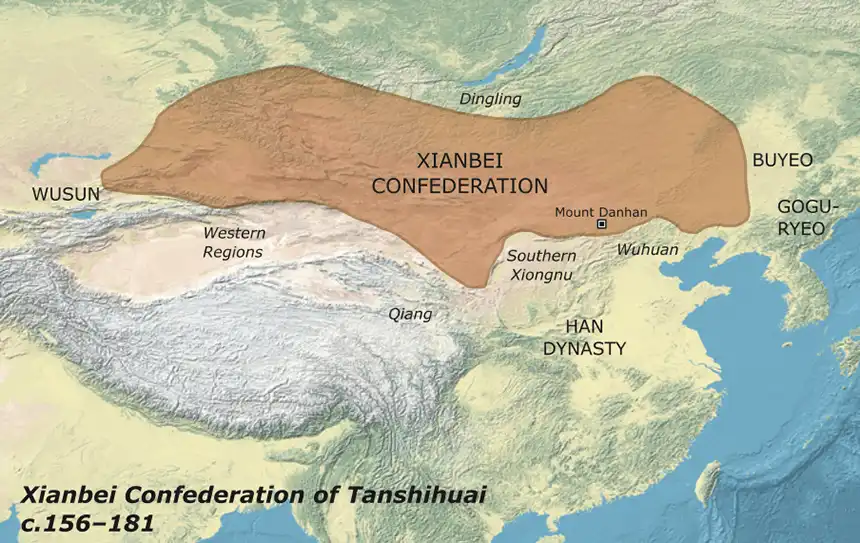
The Xianbei were the great nomadic confederation of the northeastern steppe, heirs of the Xiongnu, who dominated the Mongolian plateau for three centuries and then — uniquely among steppe peoples — founded the ruling dynasties of north China itself. The Northern Wei, the Northern Qi, the Northern Zhou, and the Sui-Tang aristocracy all sprang from the Xianbei military world. To understand the Tang, one must understand the Xianbei: its blood, its army, and its tribal aristocracy were the dynasty's own inheritance.
Heirs of the Xiongnu
The Xianbei emerged from the wreckage of the Xiongnu empire. When the Xiongnu collapsed at the end of the first century AD, their former subjects on the eastern steppe — the Donghu peoples, already broken by the Xiongnu three centuries earlier — regrouped under the name Xianbei, occupied the abandoned Xiongnu lands from the Great Bend of the Yellow River to the forests of Manchuria, and absorbed much of the Xiongnu population itself. In the second century they became China’s northern problem under the confederacy of Tanshihuai (r. c. 156–181), whose raids matched the Xiongnu’s at their height and whose confederation, by the Chinese histories’ count, fielded a hundred thousand bowmen; the Han bought him off with titles and he-gifts until his death dissolved the union into its tribal fragments.
The Conquest of the North
The fragmentation was temporary, and the direction of Xianbei history now bent south of the Great Wall. Through the third and fourth centuries — the age of China’s division after the fall of the Han — Xianbei tribal groups moved into the agricultural north, fighting as frontier auxiliaries, then conquerors, then rulers. The results were the Northern dynasties: the Former Yan and Later Yan of the Murong clan, the Western Qin, the Southern and Northern Liang, and above all the Northern Wei (386–534) of the Tuoba clan — the first and greatest of the barbarian dynasties, which unified the north in 439 and ruled it for a century from its capitals at Datong and Luoyang. The Northern Wei’s sinicization program — its edicts of Xiaowen (r. 471–499) ordering the court to speak Chinese, wear Chinese dress, and take Chinese surnames (Tuoba becoming Yuan) — became the template for every later conquest dynasty’s dilemma: how to rule China without becoming it, and how to become it without losing the military edge that won the throne.
The Aristocracy and the Tang
The Xianbei legacy ran directly into the Tang through the Guanlong — the “guards and garrisons” aristocracy of the northwest — the intermarried military elite of the Western Wei, Northern Zhou, Sui, and Tang. The founding families of these four dynasties were, in large part, Xianbei or heavily Xianbei-mixed: the Yuwen who founded the Northern Zhou, the Dugu sisters whose marriages bound the Northern Zhou, Sui, and Tang into one family, the Houmochen, and the Li family of Longxi itself, whose matriarchs were Xianbei and whose customs — the levirate marriage practices, the felt tents at court, the hunting and polo, the women of the family riding and ruling — remained steppe in flavor long after the founding. Li Yuan’s own mother was a Dugu; his consort Duchess Dou was from a Xianbei clan; the Tang dynasty’s famous openness to women and foreigners, its cavalry army, its cosmopolitan court, are all, in substantial measure, the Xianbei inheritance wearing Chinese dress.
Historical Assessment
The Xianbei accomplished what no steppe people managed before the Mongols: they did not merely raid or occupy China, they produced China’s ruling houses for three centuries and rebuilt the empire’s institutions from within. Their dynasties invented the equal-field and fubing systems the Tang inherited and perfected; their aristocracy staffed the Sui and Tang courts; and their assimilation — the gradual dissolution of the Xianbei as a named people into the Chinese population of the north by the Tang period — is the great success story of Chinese cultural absorption, so complete that later ages forgot the dynasty was half-foreign at all. Modern historians, recovering the record, describe the Tang as a “conquest dynasty” of the second generation — and the Xianbei are the reason the description fits.
References & Historical Sources
- Fan Ye, Book of Later Han (Hou Hanshu), monograph on the Xianbei.
- Chen Shou, Records of the Three Kingdoms; Fang Xuanling et al., Book of Jin, for the Sixteen Kingdoms.
- Wei Shou, Book of Northern Wei (Weishu), for the Tuoba dynasty and its sinicization.
- Arthur F. Wright, “The Northern Dynasties” (in Cambridge History of China, vol. 2).
- Chen Yinke, Sui Tang zhidu yuanyuan lüelun gao (1944), on the Guanlong aristocracy.