The Western Turkic Khaganate (c. 603–659)
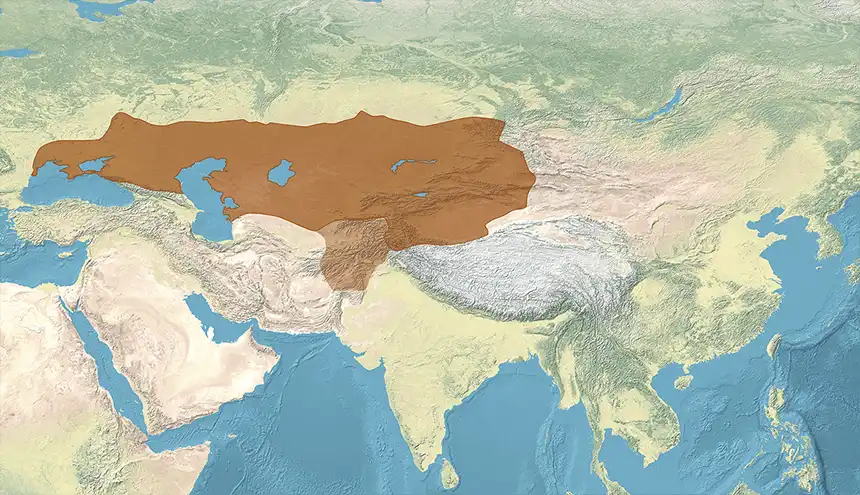
The Western Turkic Khaganate — the Onoq, the 'Ten Arrows' — was the western half of the great Turkic steppe empire, ruling from the Altai to the Pamirs through the first half of the Tang dynasty. For two generations it was the decisive power of inner Asia: master of the Silk Road, kingmaker of the oasis cities, and the Tang's indispensable rival in the west. Its destruction by Tang armies in 657 opened the road to Tashkent and made the Tang master of the Tarim Basin — the farthest west Chinese power has ever reached.
The Split of the Turkic Empire
The first Turkic Khaganate — the Tujue of the Chinese records, founded by the Ashina clan on the Mongolian plateau in 552 — united the steppe from Manchuria to the Caspian in a single military confederation, the largest steppe empire the world had yet seen. Its unity lasted barely two generations. From 603, wars of succession and geography pulled the empire apart along the line of the Altai: the Eastern Khaganate faced China across the Gobi, while the western khans built their own confederation on the pastures of the Ili, the Chu, and the Talas — the Onoq, “ten arrows,” from the Chinese record of its ten tribal divisions (two wings of five tribes each), organized under their own yabghus and the khagan of the west. The Western Khaganate’s capitals lay far from China: Suyab in the Chui valley (near modern Bishkek) and, for Tong Yabgu’s dazzling reign, summer quarters near Tashkent.
The Apogee under Tong Yabgu
The Western Khaganate’s golden age was the reign of Tong Yabgu Qaghan (r. 618–630), exactly the years of the Tang founding. Tong Yabgu ruled from the Black Sea approaches to the Pamirs; the Sogdian merchant cities lived under his protection and paid him their tithes, the oasis kingdoms of the Tarim — Kucha, Khotan, Kashgar — were his tributaries, and the Sasanian Persians and Byzantines alike sent embassies to his camp. His cavalry fought on every frontier: against Persia, against the Khazars, and — decisively for Tang history — against the Eastern Turks, whose 630 collapse owed much to the Western khagan’s hostility. The Chinese and Arabic sources both preserve the era’s scale: Xuanzang, passing through the khaganate’s lands in 630, describes Tong Yabgu holding court in a golden yurt hung with silk before an army of 200,000; the Muslim historians remember the khagan who ruled the road to China. For a single generation, the master of the western steppe was the most powerful man in Asia between Byzantium and the Tang.
The Tang Destruction
The end came with bewildering speed, and from the direction no steppe state feared — China unified and aggressive. Taizong’s destruction of the Eastern Turks in 630 left the western khans nominally supreme on the steppe but stripped of their eastern leverage; thereafter the khaganate was weakened by the same disease that killed its parent — succession wars among Ashina claimants, with the Tang playing kingmaker among the rivals and resettling thousands of surrendered Turks inside the Chinese frontier as mounted auxiliaries. In 657 Gaozong’s general Su Dingfang — the same commander who had destroyed Baekje three years earlier — led a converging winter campaign into the western steppe: one Tang column crossed the desert west of the Tarim, another advanced up the Ili, and the khaganate’s army, caught between them on the Irtysh, was scattered in a battle fought in a storm. The last khagan, Helu, fled toward the Oxus and was delivered to the Tang by his own followers. He was brought to Chang’an; the Western Turkic Khaganate ceased to exist.
Aftermath and Legacy
The conquest made the Tang master of the Tarim Basin and the approaches to the Pamirs — the protectorate system of the Four Garrisons, headquartered at Qiuci (Kucha), now stood where the khaganate’s tributaries had been. But the khaganate’s ghost haunted the west for a century: the tribal fragments regrouped under new names — the Onoq elements became the Türgesh and then the Karluk confederations, some of the western tribes drifted beyond the Jaxartes to found, with the Khazar connection, the Khaganate of the Khazars on the Volga. At Talas in 751 it was Karluk tribesmen, heirs of the Onoq, who turned the battle against the Tang. And the deepest legacy was political: the Tang’s experience of the Turks — first as the mortal enemy of the founding generation, then as auxiliaries, settlers, and generals of the dynasty — taught the Chinese state the steppe’s enduring lesson, that the border peoples could not be kept out but could be enrolled, and that the khagan’s title, as Taizong’s own acceptance of the Heavenly Qaghan’s crown showed, was a tool of statecraft in Chinese hands as surely as in Turkish ones.
References & Historical Sources
- Old Book of Tang and New Book of Tang, monographs on the Turks (Tujue zhuan).
- Zizhi Tongjian, volumes 193–200.
- Xuanzang, Great Tang Records on the Western Regions, on Tong Yabgu’s court (630).
- Abu al-Ghazi Bahadur Khan, Genealogy of the Turks (17th c.), for the steppe tradition.
- Colin Mackerras, The Uighur Empire (1972), and Christopher I. Beckwith, The Tibetan Empire in Central Asia (1987).