Western Liang (400–421)
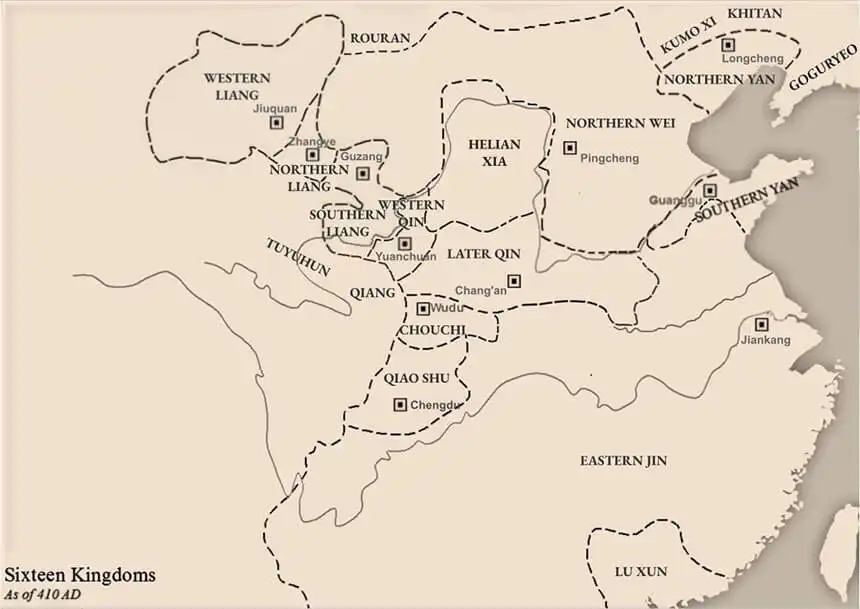
Western Liang was a small dynastic state of the Sixteen Kingdoms period, founded in 400 by the Li family of Dunhuang and extinguished in 421. Its armies never ruled more than the western Gansu corridor, and its three dukes reigned in the shadow of stronger neighbors. Yet the Western Liang occupies an outsized place in history: the Tang dynasty's founding house traced its ancestry directly to the Western Liang rulers, and through them to the Han general Li Guang and, in Tang ideology, to Laozi himself.
The State of Dunhuang
The Western Liang was born from the wreckage of the Former Liang, the Chinese-ruled state that had held the Gansu corridor since the collapse of the Western Jin. When the Later Liang’s ruler Lü Guang decayed into suspicion and his state fractured, the Dunhuang commandant Li Gao — a member of the local Li gentry, born in 351 — was elected by the region’s great families in 400 to lead a separatist state, taking the title Duke of Liang. His little realm comprised Dunhuang, Jiuquan, and the oasis towns of the far western corridor: rich from Silk Road transit trade, cultured, and hopelessly outmatched. Li Gao was a model frontier ruler — he promoted agriculture and sericulture, kept his court frugal, patronized scholarship, and wrote his own proclamations — and his state survived on diplomacy: nominally tributary to the Eastern Jin across the Yangzi (whose legitimacy the Liang court explicitly claimed to uphold against the barbarian usurpers of the north) and carefully balanced between the stronger Liang states on either side.
The Three Dukes
The succession undid the state. Li Gao died in 417, and his heir Li Xin — competent but rash — provoked the rising Northern Liang, the Xiongnu-led state to the east, into open war. In 420 Li Xin led his army against the Northern Liang capital and was defeated and killed in the field; his brother Li Xun held Dunhuang for another year and then, in 421, killed himself as the Northern Liang armies closed in. The state that Li Gao had built over seventeen years was extinguished in two. The Li family, however, was not: Li Gao’s descendants scattered eastward into the Northern Wei and its successors, carrying their genealogy and their claims through five centuries of the northern aristocracy.
The Ancestral Claim
The Longxi Li lineage — the genealogy of the Tang imperial house — runs through the Western Liang by explicit Tang design. Emperor Gaozu’s family traced its patrilineal line to Li Gao himself, and the Tang histories elaborated the chain backward to the Han frontier general Li Guang and the Han scholar-official Li Er, the sage Laozi, in the paternal line. The claim served the dynasty’s ideology on every level: it connected the new imperial house to the martial glory of the Han, to the civil virtue of the Han scholars, and to the divine ancestry of Laozi that the court was simultaneously canonizing as its state theology. Tang ritual honors to Li Gao were maintained at the dynastic temple: he received posthumous imperial titles, and his tomb at Dunhuang was incorporated into the dynastic mausoleum system in the empire’s west, where it remains to this day.
Historical Assessment
Historians have long debated how much of the Tang genealogy to credit. The Longxi Lis were unquestionably a real and distinguished northwestern aristocratic clan, traceable with reasonable security for several generations before Li Yuan; the deeper reaches — to Li Gao, to Li Guang, and above all to Laozi — belong to the normal work of dynastic legitimation, in which every Chinese founding house constructed a suitable past. What is certain is the direction of the construction: of all the ancestors the Tang might have claimed, it chose a small, virtuous, doomed state of the Gansu corridor whose founding duke was remembered as a scholar-ruler faithful to a lost legitimate dynasty. The choice says everything about how the Tang wished to be seen — civil, tenacious, and heir to the Han — and nothing reliable about where, two centuries earlier, the genealogy actually bends.
References & Historical Sources
- Jin Shu (Book of Jin), “Record of Li Gao” (Li Gao zaiji), the principal account of the Western Liang.
- Old Book of Tang and New Book of Tang, the imperial genealogy (Zongshi shixi biao) and the monograph on the imperial clan.
- Zizhi Tongjian, volumes 111–116.
- Chen Yinke, Tangdai zhengzhi shi shulun gao (1943), on the Tang aristocracy’s genealogical claims.