Silla and the Tang Wars in Korea
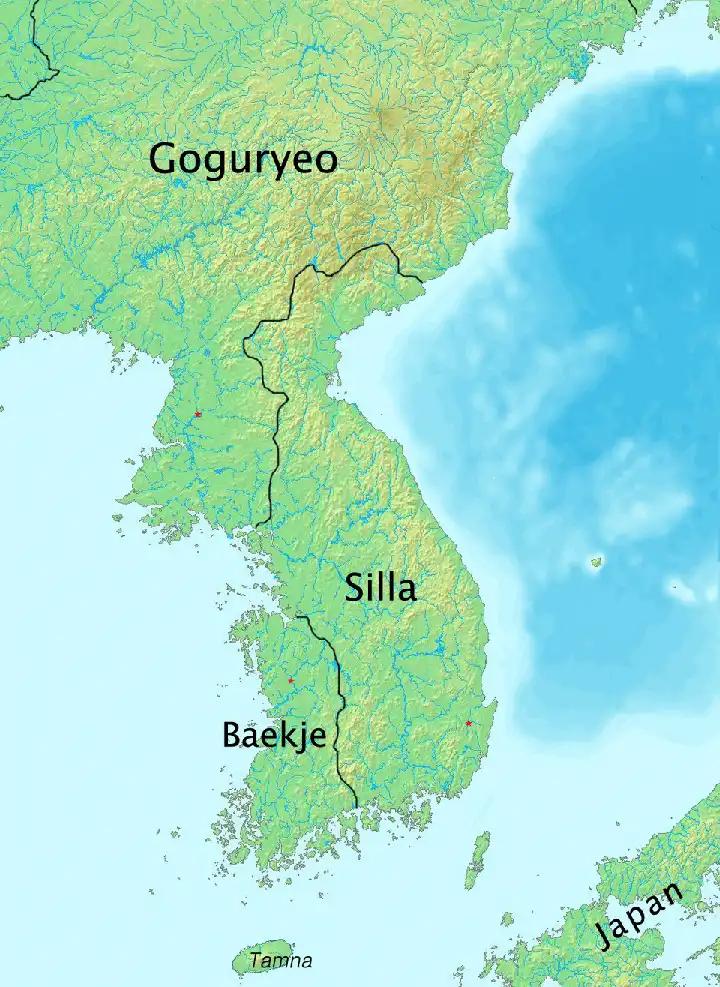
Silla (57 BC – 935 AD), the Korean kingdom of the southeast, was the Tang dynasty's indispensable ally and then its most successful enemy. Allied with Tang armies it destroyed Baekje in 660 and Goguryeo in 668 — the two kingdoms that had resisted Chinese power for centuries — and then, within five years, turned on its ally and expelled Tang garrisons from the peninsula. The result, Unified Silla, was the first state to rule nearly the entire Korean peninsula; the Tang had destroyed its enemies and created its rival in a single war.
The Three Kingdoms
For the first seven centuries AD the Korean peninsula and southern Manchuria were divided among three rival kingdoms. Goguryeo, the hard northern state of walled cities and mountain fortresses, had broken the Sui dynasty’s three invasions and contested the Liaodong region with every Chinese dynasty since the Han. Baekje, on the southwest coast, was a maritime and Buddhist kingdom with close ties to Japan. Silla, in the southeast, was for centuries the smallest of the three — hemmed in by its neighbors, saved by mountain defenses, and increasingly drawn toward the great powers across the sea. Under King Jinheung in the sixth century Silla swallowed the Gaya confederacy, took the Han River basin from Baekje, and began the centralization that would make it Korea’s unifier; its kings took the title of Great King and built at Gyeongju one of the great courts of East Asia.
The Alliance with Tang
The marriage of convenience was forged in desperation. In the 640s Goguryeo and Baekje, alarmed by Silla’s rise, coordinated against it; Silla’s Queen Seondeok sent envoys to Tang Taizong and his successors proposing the partition of the peninsula, and from 645 the Silla court and the Tang war effort — Taizong’s great invasion of Goguryeo — ran in parallel, though Taizong’s campaign broke against Ansi fortress and the king returned empty-handed. The alliance was consummated under his son: in 660 Su Dingfang’s Tang fleet and army, cooperating with Silla’s Kim Yu-sin, landed on the Baekje coast and destroyed the southern kingdom in weeks; in 668 the combined armies stormed Pyongyang, and Goguryeo — after two centuries of defying Chinese power — fell. The Tang established its rule over the old Goguryeo lands as the Protectorate-General of the Andong, with protector-generals seated first in Pyongyang itself, and Silla’s King Munmu received the Tang investiture as ruler of the peninsula.
The Turn: Silla Against Tang
The settlement collapsed almost immediately, because the two allies had understood it differently. The Tang intended the Andong Protectorate as the permanent administration of the north, with Silla as a subordinate tributary; Silla had understood the war as the recovery of all lands ever held by the Three Kingdoms — including, by Silla’s reckoning, everything to the Taedong River. King Munmu’s forces attacked the Tang garrisons in 670, and the war that followed lasted five years: the Sillans destroyed the Tang forces piecemeal — most famously at the Battle of Hwangsanbeol and the siege of the Pyongyang garrison itself — and by 676 the protectorate had collapsed, its surviving garrisons withdrawn north of the Yalu. The Tang court, preoccupied with the Tibetans and the loss of the Western Regions, chose not to renew the attempt. The peninsula south of the Taedong became Unified Silla; north of it, the refugee Goguryeo general Dae Joyeong founded Balhae in 698, and the Tang-Silla frontier settled into a stable, formally tributary peace that lasted two centuries.
Historical Assessment
The Korean wars carry a double verdict on Tang power. They show its height: in 668 Tang armies stood from Persia’s border to Pyongyang, and no contemporary power matched that reach. And they show its limits: the peninsula that Chinese dynasties had fought to control since the Han passed definitively beyond direct rule, and the pattern set in 676 — a unified Korea, formally tributary, actually independent — became one of the most durable settlements in East Asian history, surviving the Ming, the Qing, and the twentieth century alike. For Silla, the century of alliance and war produced the golden age of Gyeongju; for the Tang, it produced a memory: the Old Book of Tang’s Korea chapters, and the vivid echoes in Korean historiography, of the longest and hardest war the golden age ever fought.
References & Historical Sources
- Old Book of Tang and New Book of Tang, monographs on Korea (Xinluo, Gaoli, and Baekje).
- Zizhi Tongjian, volumes 197–202.
- The Samguk Sagi (History of the Three Kingdoms, 1145), the Korean narrative counterpart.
- Jonathan W. Best, A History of the Early Korean Kingdom of Paekche (2006).
- Rhee Song-nai, “The Silla-Tang War” (Korea Journal, 1977).