Military Systems
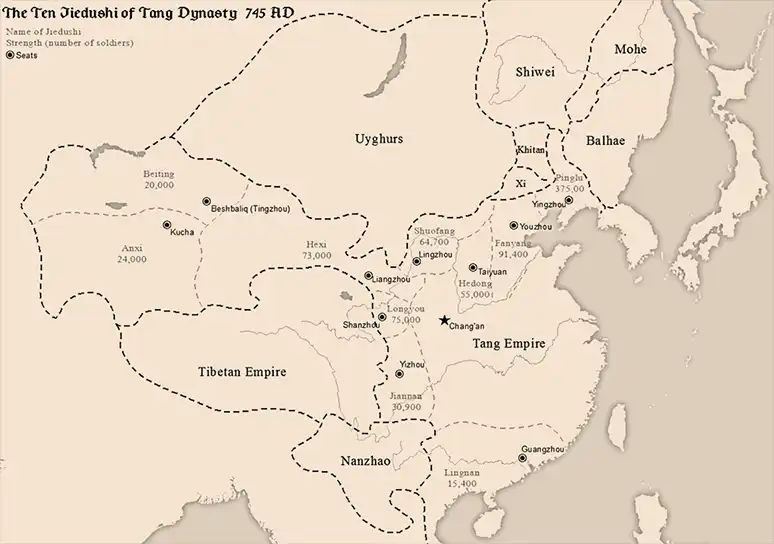
The Tang dynasty ran three successive military systems in three centuries, and the story of its fall is the story of the third. The fubing hereditary militia built the conquests of the golden age; the professional frontier commands carried Tang arms to their farthest reach; and the jiedushi military governorships — the very institution created to defend the empire — became the warlord regimes that devoured it. This page traces the institutional evolution of Tang arms from militia to warlord.
The Fubing: The Militia of Conquest
The early Tang army rested on the fubing system, inherited from the Western Wei and Northern Zhou and refined under the Sui. Its premise was elegant: the state allotted land to farming households and in return received soldiers — hereditary military households whose adult males trained in the agricultural off-season, equipped themselves, and assembled for campaign when the court summoned the regimental banners. Some six hundred garrisons, concentrated in the north around the capitals and the frontier, provided the Tang with perhaps 600,000 men on the rolls and, in practice, disciplined field armies whenever needed — without a standing professional army’s crushing cost. Under the fubing the Tang conquered at a pace the Han never matched: the Turks in 630, the Tuyuhun in 635, the oasis cities garrisoned by 640, the Korean wars of the 640s–660s. The system’s weaknesses were equally structural: the garrison households aged, the long frontier wars kept militiamen under arms for years, and the equal-field land base that supported them eroded. By the 660s the fubing was hollow, and the dynasty began the fateful shift to professionals.
The Frontier Commands and the Rise of the Jiedushi
The professional frontier army was at first a patchwork answer to patchwork problems: area commands (zongguan fu, later dudu fu) placed under veteran generals with temporary powers to hold specific sectors. In 711 the court regularized the experiment with a new title — jiedushi, “military commissioner” — authorizing its holders to supervise several prefectures’ defenses, maintain standing armies, collect local revenues, and appoint their own subordinates. The early jiedushi were the instruments of expansion: they held the Anxi garrisons, built the cavalry that rode to Talas, and guarded the northeast where An Lushan rose. But the design contained a loaded gun. A jiedushi commanded troops whose pay, provisioning, and promotions ran through his own staff; he sat atop the local revenue he was meant to defend; and the court, a thousand li away at Chang’an, could confirm or remove him but could not watch him. By the 740s the ten great jiedushi — An Lushan holding three of them — commanded the empire’s best armies with near-total local autonomy.
The Rebellion and Its Settlement
In December 755 the gun went off. The An Lushan rebellion demonstrated what the institution had become: when three northeastern commands marched on the capital, the court could field against them only palace guards and hastily raised levies, and the two capitals fell within months. The dynasty survived — saved by Guo Ziyi’s armies, Uyghur cavalry, and the rebels’ own murderous leadership — but the peace settlement of 763 institutionalized the disaster: to end the war, the court confirmed the surrendered rebel generals as jiedushi of their own territories. The northeastern circuits — the “Three Fanzhen of Hebei” centered on Weibo, Chengde, and Lulong — became hereditary military states, passing from father to son without imperial approval, paying little tax, and choosing their own officers. Elsewhere, jiedushi multiplied until the empire carried dozens of them, the loyal ones kept loyal by salary, the rest by calculation. The late Tang state was a court negotiating with its own uniformed provinces — taxing the southeast to pay for the armies it hoped would not need to be used against it.
From Jiedushi to Five Dynasties
The final transformation came in the 880s. When Huang Chao’s rebellion shattered the court’s remaining authority, the jiedushi who defeated him — above all Zhu Wen of Xuanwu, whose Kaifeng base commanded the Grand Canal — took their payment in sovereignty. Zhu Wen’s murder of the last two emperors and usurpation in 907 was only the northeastern hereditary principle extended to the throne itself. The Five Dynasties that followed were, in a strict institutional sense, the jiedushi system running the whole country: five military governors in succession holding the north by the same means — army, revenue, and appointment power — that the Hebei fanzhen had exercised for a century. The Song dynasty that ended the age in 979 understood precisely what it was abolishing, and its first act was the demilitarization of the provinces — the civil official sent from the center to govern every prefecture, the army under central pay and central command. The jiedushi title survived, empty, into the Yuan; the memory of what it had done shaped Chinese statecraft for the next thousand years.
References & Historical Sources
- Old Book of Tang and New Book of Tang, treatise on the army (Bingzhi).
- Zizhi Tongjian, annals of the An Lushan rebellion and its settlement.
- Denis Twitchett, “The T’ang Military Governorship” (Cambridge History of China, vol. 3).
- Chen Yinke, Tangdai zhengzhi shi shulun gao (1943), the classic analysis of the fanzhen problem.