Famous Battles
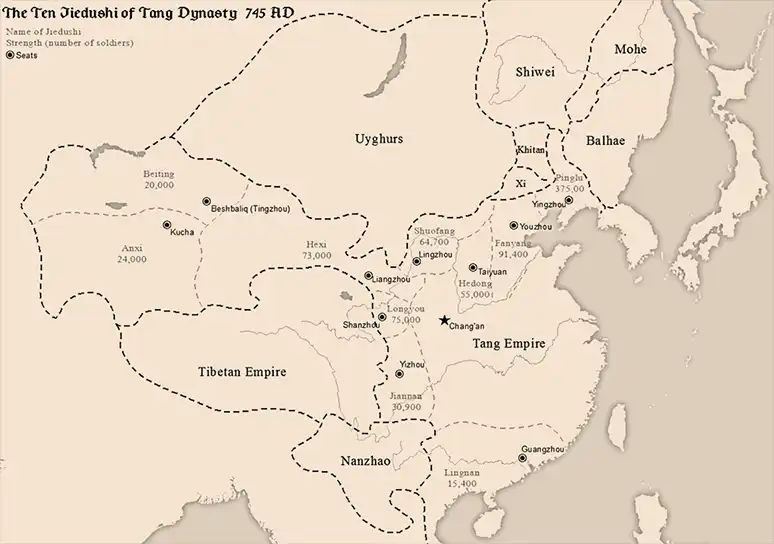
The Tang dynasty's destiny was settled in a handful of battles — sudden, violent encounters where the empire's future turned on a single day's fighting. From the founding wars at Hulao to the frontier confrontation at Talas and the suicidal defeat at Tong Pass, these engagements decided who would rule China, how far its power would reach, and whether it would survive its own soldiers. This page surveys the battles that made and nearly unmade the dynasty.
Hulao, 621: The Battle That Founded the Dynasty
The decisive battle of the founding wars came on 28 May 621, when Li Shimin’s Tang army met the allied forces of Dou Jiande’s Xia and Wang Shichong’s Zheng at Hulao Pass in Henan. Dou had marched to relieve Wang, besieged in Luoyang; Li, younger and outnumbered, refused battle for weeks, letting the summer heat and the siege work on the enemy, then struck at midday as Dou’s army rested. The Xia host collapsed in hours; Dou was captured and later executed, Wang surrendered, and the two strongest rivals to the Tang were destroyed in a single afternoon. No other battle of the era carried such consequences: by the end of 621 the Tang’s unification of China was no longer in doubt, only a matter of mopping up. Li Shimin’s conduct at Hulao — patience, intelligence preparation, and the perfectly timed shock — became the textbook example of Chinese generalship, studied by every military writer after.
The Iron Mountain, 630: The End of the Turkic Menace
In the winter of 629–630, Li Jing led ten thousand picked cavalry in a forced march across the frozen steppe to the Iron Mountain on the Orkhon River, the sacred heartland of the Eastern Turkic Khaganate. Jieli Khan, caught at the feast of a false truce negotiation, fled into a blizzard and was run down and captured. The Khaganate — two centuries of China’s northern nightmare — ceased to exist in weeks. Taizong was acclaimed Heavenly Qaghan by the steppe tribes, and the victory set the pattern of the Tang’s golden-age wars: light, fast, deep strikes by mixed Chinese-steppe cavalry, aimed at the enemy’s political center rather than his border forts.
The Yalu and the Goguryeo Wars, 645–668
The wars against Goguryeo were the early Tang’s great frustration and its final triumph. Taizong’s personal invasion of 645 — the largest amphibious and mountain campaign of the age, praised by his own historians for its conduct — broke against the fortress of Ansi after a heroic defense the Koreans remember still. It was left to his successors to finish the work: Gaozong’s general Su Dingfang destroyed the Baekje kingdom in 660, and in 668, Tang and Silla armies working in concert stormed Pyongyang and extinguished Goguryeo after two centuries of resistance. Korea would never again field a state able to contest Chinese power on the peninsula until the Ming.
Talas, 751: The Far Frontier
On the Talas River in modern Kazakhstan in July 751, the armies of Tang and the Abbasid Caliphate met in the most westerly battle in Chinese history. Gao Xianzhi’s corps, with Karluk auxiliaries who changed sides in the fighting, was defeated and driven back over the Pamirs; the Tang held its garrisons for another decade, but the possibility of further expansion westward died at Talas. The battle’s legends — that Chinese papermakers taken captive founded the paper industry of Samarkand — matter less than its reality: two of the world’s great powers had met at the edge of their reach, measured each other, and turned away.
Tong Pass, 756: The Battle That Should Never Have Been Fought
The most consequential Tang defeat was an act of court insanity. With An Lushan’s rebels advancing on the capitals, the veteran generals Gao Xianzhi and Feng Changqing correctly held the impregnable Tong Pass, waiting for the overextended rebels to rot. The court — panicked and poisoned by the favorite Yang Guozhong’s assurances — ordered the army out to battle; it was surrounded and destroyed, both generals executed on a eunuch’s slander, and the road to Chang’an lay open. The dynasty survived, but the battle’s lesson entered Chinese political memory permanently: a government that murders its own generals at the pass will meet the enemy in the capital.
References & Historical Sources
- Old Book of Tang and New Book of Tang, treatise on the army (Bingzhi); annals of the founding, Taizong, Gaozong, and Xuanzong.
- Zizhi Tongjian, volumes 189 (Hulao), 193–194 (Iron Mountain), 198–201 (Goguryeo), 216 (Talas), 217 (Tong Pass).
- Li Jing, Li Weigong Bingfa, the classical commentary on the campaigns of 629–630.