Zhang Jiuling
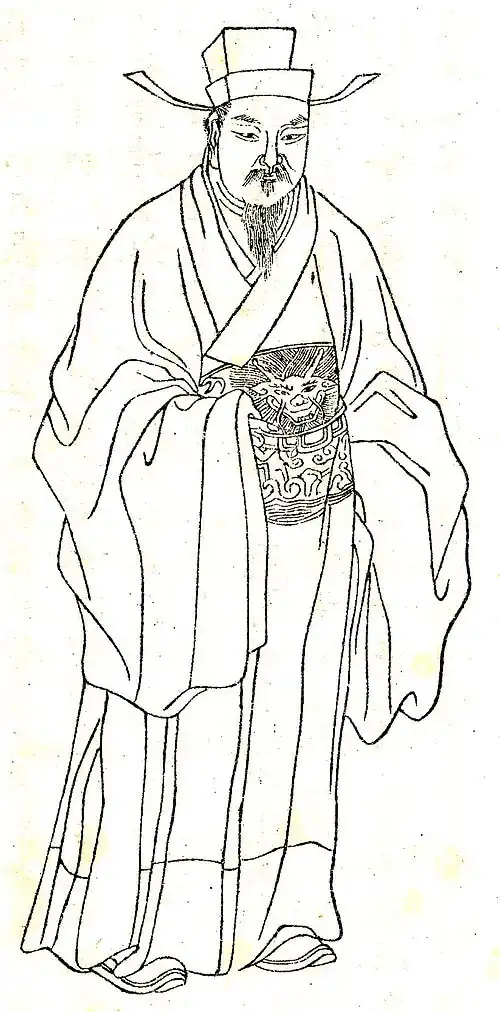
Zhang Jiuling (678 – 5 June 740), courtesy name Zishou, was a poet-statesman of the southern gentry who rose through the examinations to the chancellorship of Emperor Xuanzong, becoming the last upright chancellor of the Kaiyuan golden age. His honesty — including the famous, ignored warning that An Lushan would rebel — and his fall before Li Linfu's flattery in 736 mark the moral hinge on which historians hang the turning of Xuanzong's reign from glory to catastrophe.
The Southern Outsider
Zhang Jiuling came from Shixing, in the far south of the empire near modern Shaoguan — a region then at the edge of the Tang political world, its inhabitants regarded by the northern aristocracy as half-foreign. His route up was the one the examinations promised: a brilliant jinshi degree in 702, followed by a career in the capital’s literary and ritual offices, where his learning in court ceremony and his growing reputation as a poet made him noticed by the crown prince’s establishment. His memorials on governance — on honest selection of officials, on the corruptions of patronage, on the emperor’s duty to hear unwelcome speech — circulated widely and impressed the hard-eyed chancellor Yao Chong. When Li Longji, the future Emperor Xuanzong, took the throne, Zhang urged him to perform the great suburban sacrifices that ritually announced a secure reign; the emperor did so, and marked the southerner’s name.
The Upright Chancellor
As chancellor from 733 (formally 734), Zhang Jiuling was the court’s conscience. He blocked appointments obtained by favor; he enforced the rule that officials be judged by performance, not by connections; and he maintained, in the Zhenguan tradition, the right and duty of the minister to oppose the emperor openly. Two of his stands became legend. When the general Zhang Shougui’s subordinate killed a man in a border incident, Zhang Jiuling refused to commute the sentence despite the emperor’s plea, arguing that law was the dynasty’s foundation — “it is precisely when the circumstances touch the throne that the law must be upheld.” And in the mid-730s he warned repeatedly, against the mockery of the whole court, that the obese, ingratiating frontier general An Lushan was a traitor in waiting; he pressed for An’s execution or removal when An failed to answer a summons, and was overruled. Xuanzong, charmed by An’s performances for the consort Yang Guifei’s circle, kept him; Zhang’s prophecy was fulfilled, almost to the letter, nineteen years later.
The Fall
His rival Li Linfu understood the emperor better. Where Zhang corrected, Li Linfu agreed; where Zhang insisted on principle, Li Linfu arranged pleasures. In 736 a manufactured court case — the so-called Bulli case involving Zhang’s allies — gave Li Linfu the opening; by 737 Zhang was stripped of the chancellorship and sent out to govern Jingzhou on the middle Yangzi, and the court’s last institutional brake on Xuanzong’s aging desires was removed. He died in 740, aged about sixty-two, still in provincial office, the poet-statesman to the end: his exile poems, homesick and wind-stirred, are among the finest of the era’s verse. The court posthumously rehabilitated and ennobled him — Count Wenxian of Shixing — but the honors came after the damage was done.
Historical Assessment
Later historians made Zhang Jiuling the emblem of the road not taken. The Zizhi Tongjian, narrating the fall, frames it as the moment the Kaiyuan government lost its moral steering; the rebellion of 755 reads in this framing as the long-delayed verdict on 736. The judgment is schematic — Li Linfu was an able administrator, and the empire’s structural problems ran deeper than one chancellor’s character — but it captures something real about the Tang ideal of governance: a dynasty that publicly modeled itself on the ruler-and-minister candor of the Zhenguan era could not survive the loss of its candor, however long the music and the taxes lasted. Zhang’s tomb and his famed “wind-fanning” exile poem in the Xiao Xiang tradition keep that ideal visible to this day.
References & Historical Sources
- Old Book of Tang, biography of Zhang Jiuling.
- New Book of Tang, biography of Zhang Jiuling.
- Zizhi Tongjian, volumes 212–214.
- Zhang’s collected works, Qujiang ji, and his poems in the Quantangshi.