Sulaiman al-Tajir
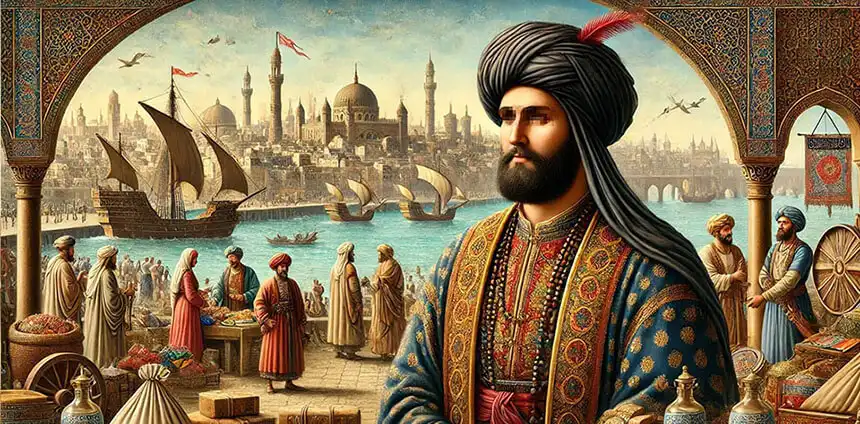
Sulaiman al-Tajir — 'Sulaiman the Merchant' — was a ninth-century Persian trader from Siraf who sailed the sea routes to India and Tang China and wrote, around 851, the first substantial Arabic account of China. His report of Guangzhou — its porcelain, its granaries, its fingerprint registers of foreigners, its Muslim quarter with its imperially appointed judge — preserves the Tang empire at its height as seen by the maritime world that traded with it, and remains a cornerstone source for Tang economic history.
The Merchant of Siraf
Sulaiman came from Siraf, the great port on the Persian Gulf coast of Fars, in the ninth century the hinge of the Indian Ocean trade: it was from Siraf that the dhows sailed to India, Sri Lanka, and the South China Sea, and Siraf’s merchant houses that financed the round voyages whose profits moved between the caliphate and the Tang empire. Of the man himself almost nothing is known beyond his nisba — al-Tajir, “the Merchant” — which itself tells the story: in the Abbasid maritime world, the merchant was a recognized profession, with recognized routes, contracts, and literature. His account, composed around 851 and later continued and transmitted by Abu Zayd al-Sirafi, belongs to the genre of the practical merchant’s handbook: routes, winds, ports, prices, and the astonishing things to be seen at the end of them.
The Voyage to China
The sea road ran from Siraf across the Gulf and the Indian Ocean to Sri Lanka — the great entrepôt where the eastern and western trades met — and then with the monsoon across the Bay of Bengal and down the Malay coast through the Straits to Guangzhou, the Khānqū of the Arab geographers. Sulaiman made the voyage in both directions and recorded what the merchant needed to know: the monsoon calendar that governed the sailing season, the dangers of piracy and storm, the Chinese practice of registering newly arrived foreigners by their fingerprints — an administrative detail the Arabic text preserves with evident astonishment — and the customs regime of the Guangzhou commission, which weighed, measured, and taxed every bale of cargo with a rigor that cut deep into the merchants’ margins but kept the trade orderly. His testimony, written a generation before Huang Chao’s sack of Guangzhou in 879 destroyed the community he describes, captures the port at its peak.
What He Saw in China
Sulaiman’s China is observed with a merchant’s eye, and its observations are gold to the historian. He describes the manufacture of porcelain — “a fine clay — they make of it basins as transparent as glass; water is seen through them” — and its export value; the granary system that fed Guangzhou’s enormous population; the tea that the Chinese drank and that Arab merchants would carry west; the system of government that impressed him as the most orderly he had seen, with its hierarchy of officials answerable up a chain of command to the emperor; and, above all, the Muslim community of the port: its mosque, its markets, its imam and judge — the judge appointed, he notes with precision, by the Tang emperor himself. His figure for Guangzhou’s Muslim dead in the catastrophe of 879, preserved in Abu Zayd’s continuation, remains the only contemporary estimate of the sack’s scale: 120,000 by the highest of the reported figures, or many tens of thousands by any count — the foreign community he had described as flourishing was, within a generation, extinguished.
Historical Assessment
Sulaiman wrote no poetry and fought no battles, yet his modest handbook does what the Tang’s own records cannot: it shows the empire as the world experienced it, from the counting-house of the customs jetty. For economic historians his account is a primary source of the first rank — the prices, taxes, and procedures of the Guangzhou trade are nowhere else recorded in such detail; for the history of technology and administration, his observations on porcelain manufacture, fingerprint registration, and granary management are equally irreplaceable. And for the Tang’s place in the world his testimony is the verdict of the world itself: that in the ninth century, the empire at the eastern end of the monsoon road was the largest, richest, and best-governed market on earth, and that the merchants of Siraf — men like Sulaiman, who wrote of it because he had seen it — knew it.
References & Historical Sources
- Sulaiman al-Tajir, Silsilat al-tawārīkh (Account of China and India), as preserved and continued by Abu Zayd al-Sirafi; French translation by Ferrand (1922), English by Mackintosh-Smith (2014).
- Ibn Khurradādhbih, Book of Routes and Provinces, for the Siraf trade network.
- Old Book of Tang, treatise on food and money; monograph on the southern ports.
- George F. Hourani, Arab Seafaring in the Indian Ocean in Ancient and Early Medieval Times (1951).