Shi Siming
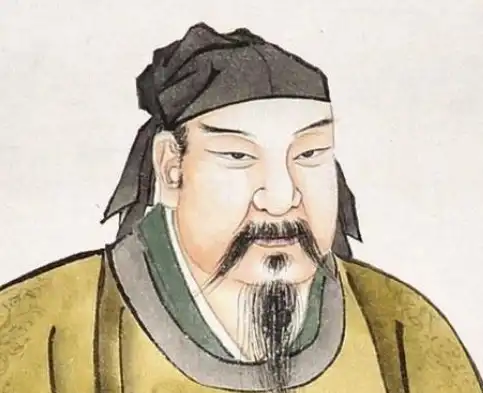
Shi Siming (703 – 18 April 761), born Shi Sugan, was An Lushan's childhood friend, fellow general, and successor — the man who kept the rebellion alive after its founder's murder and very nearly took Chang'an in 760. A general of Turkic origin with a genius for cavalry war and a temper that destroyed everyone around him, he ended as the rebels' second murdered emperor, strangled by his own son's order. Between him and An Lushan stands the proof that the rebellion of 755 was not one man's madness but a movement of the northeastern military world.
Friend of the Founder
Shi Sugan was born a day after An Lushan — the Old Book of Tang preserves the detail as omen — to a poor Turkic family in the same northeastern frontier society that produced his friend: the multi-ethnic military towns where Chinese, Sogdians, Turks, and Kitans mingled and careers were made by horse, bow, and nerve. Like An, he was poor, proud, and looked down upon; like An, he married above his station — a Miss Xin, of local gentry, who chose him against her family’s will. The two friends served together on the northeastern frontier under the same patronage, rose together through the wars against the Khitans, and were marked together as the northeast’s coming men. When An Lushan took the three great military governorships, Shi Siming was his right hand — the field commander of the rebellion’s best troops.
The War’s Second Founder
When the rebellion’s leadership began to devour itself — An Lushan murdered by his son An Qingxu in January 757 — Shi Siming was the strongest man in the rebel state and, for a time, its most dangerous free agent. Holding the northeast with an army the Tang could not touch, he negotiated with the Tang court itself, was bought off with a pardon and a governorship, and then, perceiving the court’s weakness, returned to the rebellion in 758 and took the Yan throne from An Qingxu in 759. As emperor he was the more dangerous enemy: a genuine soldier to An Lushan’s courtier, he restored the rebels’ discipline, led from the front, and in 760–761 launched the war’s most dangerous offensive, smashing Tang armies at Xiangzhou and driving deep toward the Tong Pass. The Tang court, by the Zizhi Tongjian’s account, faced its darkest hour of the entire war — and was saved by the temper of one man.
The Death of Temper
Shi Siming’s cruelty was systematic and his rages homicidal. He had massacred surrendered Tang garrisons at Weizhou and Beizhou in 759 after swearing them safety — the breach of faith, the histories record, that convinced the northeastern cities to resist him to the end — and in 761 he turned on his own. Campaigning against the Tong Pass approaches in the spring of 761, he hectored his son and heir Shi Chaoyi over minor failures, and in a characteristic rage declared before the army that after taking Shan Prefecture he would kill the boy. The declaration passed around the camp that night; Chaoyi’s officers, facing death by the father’s whim, offered their prince the classical choice — kill or be killed. On the night of 18 April 761 they ambushed Shi Siming in his camp, bound him, and set out for Luoyang; when rescue seemed possible on the road, one of them strangled him in the litter. His son took the throne and, two years later, the dynasty’s armies completed what the father had begun: the Yan state fell in 763, and Shi Chaoyi hanged himself in flight.
Historical Assessment
The dynastic histories needed Shi Siming as the second monster of the pair — the “Shi” of the “An-Shi rebellion,” the name by which Chinese tradition knows the whole eight-year catastrophe — and they wrote him accordingly: a man without faith, without mercy, and without luck. Modern historians, less concerned with moralized villainy, see him as something more instructive: the true military heart of the northeastern rebellion, whose personal competence nearly reversed the war in 760, and whose death by his own camp’s hand shows the movement’s deepest weakness. The An-Shi rebellion was never a conspiracy; it was a frontier military society in arms, and it could be led by a courtier like An Lushan or a soldier like Shi Siming — but it could only be held together by a man whom its soldiers did not fear too much to murder.
References & Historical Sources
- Old Book of Tang, annals of Suzong; biographies of Shi Siming and An Lushan.
- New Book of Tang, biographies of the rebel generals.
- Zizhi Tongjian, volumes 220–222.