Shangguan Wan'er
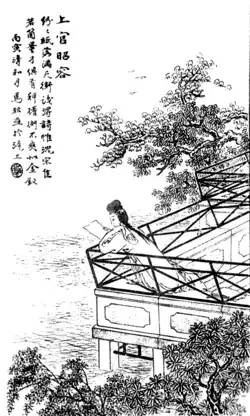
Shangguan Wan'er (c. 664 – 21 July 710) was the most powerful woman at the Tang court below the throne itself. Born into a disgraced official family and raised inside the palace as a slave, she rose to draft imperial edicts for Empress Wu, served as consort and political director of Emperor Zhongzong's restored court, judged the empire's poets, and patronized the culture of an age — before dying, at forty-six, in the coup that destroyed Empress Wei. Contemporaries called her a female chancellor; later centuries remembered her as the archetype of the woman who governed through her writing.
From Prisoner’s Daughter to Palace Secretary
Her beginnings were as low as the court permitted. Her grandfather, the chancellor Shangguan Yi, had been executed in 664 for drafting the edict by which Emperor Gaozong deposed Empress Wu; his infant granddaughter was spared but enrolled as a palace servant, a slave of the inner quarters. Empress Wu — usurper, connoisseur of talent, and collector of enemies’ children — discovered the girl’s literary gift and made her personal secretary. By the time Wu took the throne as emperor of her own Zhou dynasty in 690, Shangguan Wan’er was drafting the state documents of the realm: memorials, edicts, and appointments flowed through her hand. The Old Book of Tang notes that her judgments on literary submissions “decided the fate of candidates and careers,” and that courtiers courted her favor with the same anxiety they brought to the throne.
The Zhongzong Court
The coup of 705 that restored Emperor Zhongzong might have ended her; instead it began her second ascendancy. Zhongzong made her his consort with the rank of Zhaorong and, more importantly, kept her at the center of government, where she drafted edicts for the restored Tang and managed the cultural apparatus of the court. She presided over the imperial poetry contests that defined the era’s literary politics — judging compositions by Li Bai’s predecessors and contemporaries, collecting the court’s verse, and making and unmaking poetic reputations. Her salon gathered the finest writers in the empire; her lovers, by the frank account of the histories, included the emperor’s own nephew and his powerful cousin Wu Sansi. Historians of the period generally conclude that she ran the paperwork of Zhongzong’s weak government while his empress, Wei, ran its politics.
The 710 Coup
When Zhongzong died suddenly in July 710 — poisoned, by the standard and probably correct account, by Empress Wei and their daughter Princess Anle — Wei moved to repeat Wu Zhao’s achievement and rule in her own right. Shangguan Wan’er, whose instincts had carried her across three regimes, drafted a compromise edict naming the young Prince Li Chongmao emperor while enlisting the formidable Princess Taiping as regent: a design that would have balanced the court’s factions. It failed. Within days, Li Longji, the future Emperor Xuanzong, stormed the palace with his guards; in the chaos, Shangguan Wan’er was dragged out and beheaded, though she met her death holding the draft edict that proved her design had aimed at regency, not Wei’s usurpation. Li Longji was unmoved.
Poetry and Reputation
Her literary judgment shaped the taste of an era — the anthologies she directed stand at the head of the Tang court-poetry tradition — and her own verse, of which a small collection survives, is polished, allusive, and characteristic of the age’s best. But her posthumous reputation was written by her executioners’ side of the family: the histories compiled under Xuanzong’s successors emphasize her consort ranks, her lovers, and her reversals, and the image of the brilliant, dangerous palace woman — the “female chancellor” who served three sovereigns and survived none of them — has dominated ever since. Modern historians read her rather as the supreme example of what literary talent could achieve in the Tang inner palace, and of what the palace finally did to it. Her tomb, excavated near Xi’an in 2013, restored her at least the dignity of her own name in her own epitaph, commissioned by the imperial court that had killed her.
References & Historical Sources
- Old Book of Tang, biography of Shangguan Zhaorong (Wan’er).
- New Book of Tang, biography of Shangguan Zhaorong.
- Zizhi Tongjian, volumes 208–209.
- Her surviving poems in the Quantangshi; the 2013 excavation report of her tomb.