Religious Figures
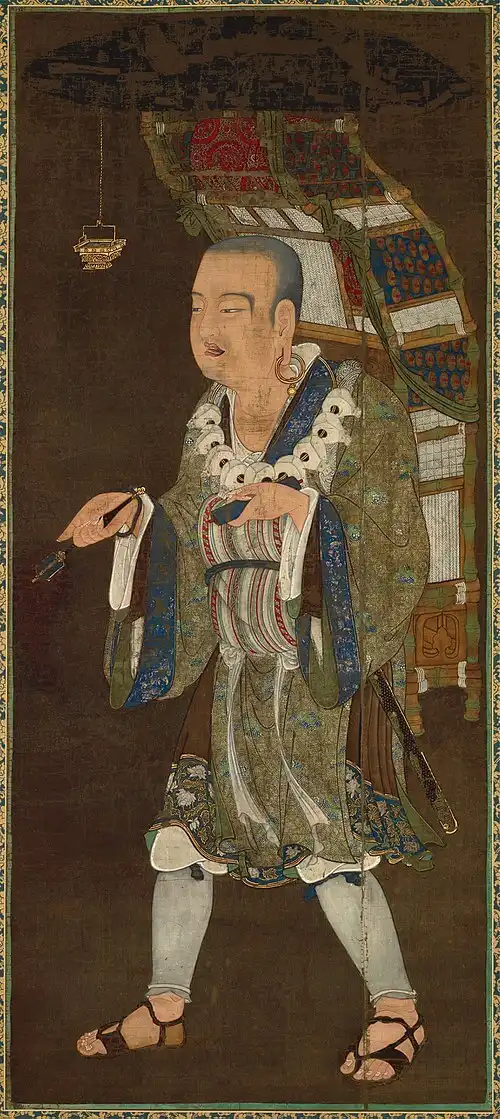
The Tang dynasty was the great age of Chinese religious exchange. Buddhism reached its Chinese zenith — translated into a vast canon, debated at the throne, and carried by Chinese monks to Korea and Japan — while Zoroastrianism, Nestorian Christianity, Manichaeism, and Islam established their first Chinese communities along the Silk Road and the southern ports. This page surveys the two towering monks whose journeys defined the era's spiritual geography: Xuanzang, who went west to India and made Chinese Buddhism his life's translation, and Jianzhen, who went east to Japan and founded its ordained tradition.
The Age of Faith
No Chinese dynasty was more religiously crowded or more religiously ambitious than the Tang. The throne patronized all Three Teachings — Confucian, Taoist, and Buddhist — while managing, taxing, and occasionally terrorizing their institutions; the great suppression of Buddhism in 845, which destroyed 4,600 monasteries, was fiscal policy executed with theological rhetoric. Against that stormy institutional background, individual faith accomplished the age’s enduring works: the translation of the Indian Buddhist canon into Chinese under imperial subsidy, the transmission of Chinese Buddhism to the Korean kingdoms and Japan, and the quiet establishment of the foreign faiths — the Persian Zoroastrian temples of the western market, the Nestorian church commemorated by the Xian stele of 781, the first mosques of Guangzhou — that gave the Tang its unique religious pluralism.
Xuanzang: The Westward Pilgrimage
Xuanzang (602–664) was the age’s greatest scholar and its most famous traveler. Troubled by the corruption of the Buddhist texts available in China, he defied the court’s prohibition and set out alone for India in 629, crossing the desert of Lop Nor — where his companions and horses died — the icy passes of the Pamirs, and the kingdoms of Central Asia to the Buddhist heartland. He studied at Nalanda under the master Silabhadra, debated the Indian scholars and won, and returned to Chang’an in 645 with 657 Sanskrit texts and the empire’s adulation: Taizong himself received him, and the emperor’s successors endowed the translation bureau through which, for the remaining nineteen years of his life, Xuanzang rendered seventy-five works — among them the Heart Sutra and the immense Yogacara treatises — into a Chinese Buddhism that bore his stamp forever. His Great Tang Records on the Western Regions, dictated at Taizong’s command, preserved for history the geography, politics, and faiths of seventh-century Asia from Samarkand to the Ganges; his fictional shadow, the Tang Monk of the Journey to the West, carried his name to every generation after.
Jianzhen: The Eastward Mission
Jianzhen (688–763), known in Japan as Ganjin, was the mirror of Xuanzang: where the pilgrim went west to bring the teaching home, the missionary went east to plant it abroad. Invited by the Japanese court to regularize the ordination of its monks, he attempted the crossing of the East China Sea six times between 743 and 754 — against the will of the Tang authorities, through shipwreck, piracy, tropical disease, and the loss of his eyesight — and succeeded on the sixth attempt, landing in Japan in 754 at the age of sixty-six to a welcome the Japanese chronicles describe in wonder. At Nara he founded Tōshōdai-ji, established the ordination platform that gave Japanese Buddhism its legitimate priesthood, and transmitted with the Vinaya everything else Chinese civilization offered: medicine, architecture, sculpture, calligraphy, and the arts of the Tang court. His dry-lacquer portrait, made in his lifetime and preserved at Tōshōdai-ji, is one of the supreme masterpieces of Buddhist art and the most haunting image of the Tang that Japan keeps.
The Two Journeys as One Story
The careers of Xuanzang and Jianzhen between them describe the Tang’s religious position exactly. China was now the center: the pilgrim came from China to the faith’s source and returned to make China the faith’s future, and the masters of the conquered southeast — Korea’s monks studied in Chang’an by the hundreds — looked to China as India was looked to before. When Xuanzang died in 664 the court suspended its business in mourning; when Jianzhen died in Japan in 763, the year the An Lushan rebellion ended, the transmission he embodied was complete and irreversible. The Buddhism of East Asia is, in its canon, its discipline, and its civilizational baggage, substantially the Buddhism these two monks carried.
References & Historical Sources
- Xuanzang, Great Tang Records on the Western Regions (Da Tang Xiyu ji).
- Huili and Yancong, Biography of the Tripitaka Master Xuanzang (Da Ci’en si Sanzang fashi zhuan).
- Old Book of Tang, annals of Taizong and Gaozong.
- Omi no Mifune, Tōshōdaiji wajō den (biography of Jianzhen); the Shoku Nihongi for the Japanese reception.