Princess Pingyang
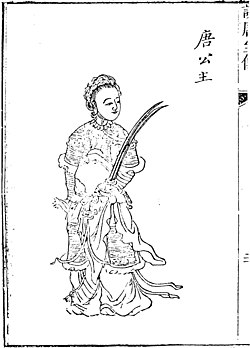
Princess Pingyang (died March 623), formally Princess Zhao of Pingyang, was the third daughter of Li Yuan, founder of the Tang dynasty — and the only Tang princess to command an army in the field. When her father raised the standard of rebellion in 617, she organized her family's escape from the capital, raised her own force — the famous 'Army of the Lady' — took several prefectures, and linked up with the rebel armies of the Guanzhong plain, commanding a force of seventy thousand by the time her father's army arrived. She remains one of the very few women in Chinese history buried with full military honors.
The Escape from Chang’an
In the summer of 617, as Li Yuan prepared his uprising at Taiyuan, his family in the Sui capital faced the dynasty’s informers. Pingyang, married to the general Chai Shao, acted first: she sent her husband to join her father’s army and then, alone, disguised herself as a man and made her way out of Chang’an to the family’s estate in Hu county, south of the capital. The Old Book of Tang’s biography — the fullest account, and sympathetic beyond its usual dryness — credits her with organizing the estate’s hundreds of retainers into a military force before the rebellion was even publicly announced, a measure of both her family’s standing and her own authority.
The Army of the Lady
Her army grew with astonishing speed. She recruited the bandit chiefs of the Guanzhong hills — He Pancheng, Li Zhongwen, Xiang Shanzi, and others, hard men who had held out against the Sui — and welded their bands into a coherent force, enforcing discipline with a strictness her ragged soldiers respected: looting was punished, the population protected, and the ranks swelled as peasants and disaffected Sui garrisons came over. By the autumn of 617 she commanded some seventy thousand troops, held several prefectures south of the capital, and had fought Sui forces sent against her — success enough that the Sui posted a special expedition against her position. When Li Yuan’s main army crossed the Yellow River that autumn, he received word that his daughter had cleared his path: the Guanzhong gates were open, the capital’s southern approaches held by her troops. In the assault on Chang’an her army joined the siege lines, and the city fell in November 617.
General and Princess
After the founding, Pingyang continued to serve as a commander — she held Hulao Pass, one of the great strategic chokepoints of the empire, and the Old Book of Tang notes her garrison service without further detail, the historians’ usual silence about what they found unclassifiable. Her marriage to Chai Shao endured the oddity of both spouses holding independent commands, and the court rewarded the pair with great estates. She died in March 623, in her twenties or early thirties, cause unrecorded. Her funeral became legend: Li Yuan, by then Emperor Gaozu, ordered her buried with the full ceremonial of a general — the band, the honor guard, the “whipping of the metal” that announced a marshal’s rites — over the protests of the court ritualists, who objected that a woman’s funeral had no precedent for military honors. The emperor’s answer stands in the histories: “She personally wielded the drum and commanded armies — she aided the founding of the dynasty. How can she be treated by ordinary precedent?”
Historical Assessment
Princess Pingyang’s career, brief as the record is, matters on three counts. Militarily, she was a genuine field commander whose forces were indispensable to the founding — the Tang captured Chang’an with an army one of whose wings was hers, a fact no amount of later male-centered editing could erase. Institutionally, her military funeral, granted by her father over ritual objection, remained the unique precedent — no other woman in Chinese history was buried with a general’s full honors. And symbolically, she became the standing exception that proves the rule: Chinese tradition could imagine a woman general when the dynasty’s survival required one, and could honor her at the grave, while returning her sex to silence in the record of everything after. Her story survives precisely because the founding could not be told without her.
References & Historical Sources
- Old Book of Tang, biography of Princess Pingyang; biography of Chai Shao.
- New Book of Tang, monograph on the imperial clan.
- Zizhi Tongjian, volume 184.