Poets & Scholars
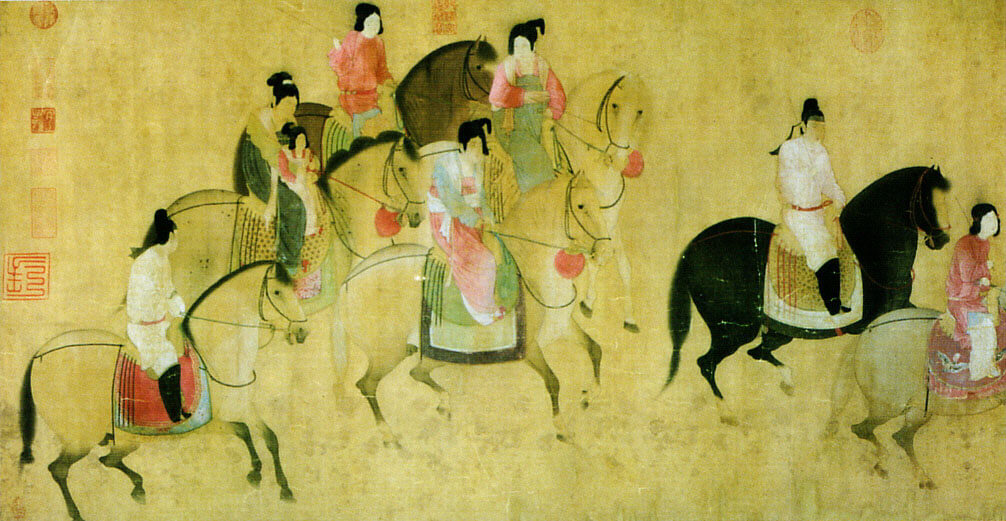
The Tang is remembered as the age of Chinese poetry's absolute summit — the era of Li Bai, Du Fu, Wang Wei, and the three hundred Tang poems every Chinese child still recites. But the dynasty's artistic greatness was not confined to verse. Its painters fixed the image of the Tang world for all later centuries, its calligraphers defined the art of the brush, and its scholars built the encyclopedic tradition on which Chinese statecraft rested. This page surveys the Tang literary and artistic achievement and the painters whose surviving works let us still see the dynasty with its own eyes.
The Age of Poetry
Tang poetry was not merely an art; it was the dynasty’s public medium — the language of examinations, court ceremony, frontier dispatches, and private grief, and the standard by which educated men measured one another. The tradition’s first great figures — the Four Paragons of the Early Tang — professionalized the regulated verse forms; the High Tang brought the unmatched constellation of Li Bai’s romantic genius, Du Fu’s moral and technical enormity (unrecognized in his lifetime, canonized forever after), Wang Wei’s Buddhist landscape serenity, and the frontier-song masters Gao Shi and Cen Shen. The mid-Tang produced Bai Juyi, whose verse was so famous it was copied on the walls of foreign monasteries, and the late Tang its own melancholy masters — Du Mu, Li Shangyin, Wen Tingyun — writing in the shadow of the dynasty’s decline. Emperor Xuanzong’s court institutionalized the art: poetry contests judged careers, and the anthology tradition that produced the Three Hundred Tang Poems began within the dynasty itself.
Painting: The Tang Eye
Tang painting survived the dynasty’s fall only in copies and tomb murals, but what survives is enough to show a revolution completed. The religious wall-painting traditions of the Buddhist temples, the court figure style descended from the Sui masters, and above all the new art of horse painting and aristocratic genre — the world of palaces, hunts, ladies, and envoys — created the visual vocabulary of all later Chinese art. The three masters collected in this section represent its range: Han Gan, the stable-hand genius who painted the imperial horses with a spiritual penetration his era found uncanny; Zhang Xuan, whose court-lady scenes preserve the texture of Xuanzong’s Chang’an; and Zhou Fang, whose plump, languorous beauties defined the Tang feminine ideal itself. Beyond them stood the legendary Wu Daozi, “the sage of painting,” whose temple walls were said to move like wind and water, and the landscape founders Li Sixun and Wang Wei, who made shan shui, mountain-water, the supreme subject of Chinese painting.
Scholarship and the Written Record
The Tang scholarly achievement underpinned everything else. The court’s great literary projects — the encyclopedia Yiwen Leiju, the historiographical bureaus that produced the dynastic histories of the earlier ages, the Buddhist and Taoist canon compilations — organized the inherited culture of all previous centuries into the reference apparatus of the imperial state. The examination curriculum fixed the Confucian canon (with Xuanzong’s addition of the Dao de jing) as the intellectual backbone of the bureaucracy; the poets who failed the examinations — Huang Chao among them — supply the tradition’s bitterest counterpoint. And the preservation instinct of the Tang elite, depositing manuscripts in the Dunhuang cave library through the ninth century, sealed away for eight hundred years the documentary heart of the medieval world: contracts, sutras, poems, and letters that modern historians read as the dynasty’s own voice.
Why It Endures
No other dynasty’s art speaks so directly to later China. Tang verse is still memorized, sung, and quoted in daily speech; Tang horses and court ladies still define the Chinese painter’s repertoire; the image of Chang’an as the world’s greatest city is, at bottom, a Tang image, kept alive by Tang words. The figures in this section painted and wrote a dynasty; what they did not know was that they were also painting and writing China for the next thirteen centuries.
References & Historical Sources
- Quantangshi (Complete Tang Poems) and Quantangwen (Complete Tang Prose).
- Old Book of Tang and New Book of Tang, treatise on literature (Jingji zhi).
- Zhang Yanyuan, Lidai Minghua Ji (Record of Famous Painters of All Dynasties, c. 847).
- Stephen Owen, The Great Age of Chinese Poetry: The High T’ang (1981); The Poetry of the Early T’ang (1977).