Laozi
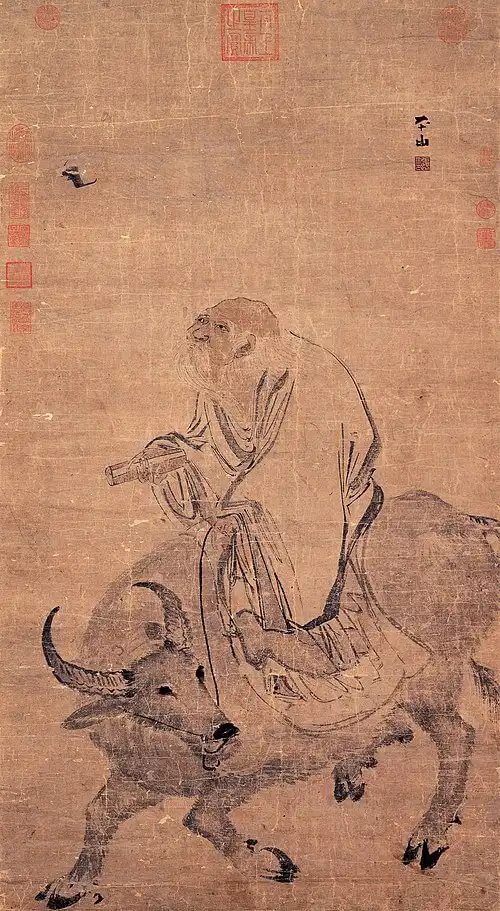
Laozi — 'Old Master', traditionally identified as the sage Li Er — is the legendary author of the Dao de jing and the founding figure of Taoism. His biography, such as it is, belongs to legend; his book is one of the most translated works in world literature. For the Tang dynasty he was something more specific: the claimed ancestor of the imperial house, canonized in 666 as a deity and patron of the state. Laozi thus stands at the head of Tang political theology as well as Taoist philosophy.
The Legendary Sage
The traditional account, drawn from the Records of the Grand Historian, makes Laozi — Li Er or Li Dan, ‘Old Master’ or ‘Old Child’, the legends playing on his name — a contemporary of Confucius and archivist of the Zhou royal library at Luoyang. Confucius, visiting him to consult on ritual, is said to have emerged awed by his wisdom, comparing him to a dragon. Seeing the decline of the Zhou, Laozi departed westward through the Hangu Pass, where the gatekeeper Yin Xi begged him to set down his teaching; the result, composed in a single session, was the Dao de jing of about 5,000 characters. He was never seen again. Modern scholarship regards the whole frame story as a later construction and the received text as a composite of Warring States strata (c. 4th–3rd centuries BCE) rather than the work of a single sixth-century author — a conclusion first argued systematically in the early twentieth century.
The Dao de jing
The book — the Classic of the Way and Its Power — is a compressed, aphoristic, and deliberately paradoxical meditation on the Dao, the ungraspable process underlying all things. Its central teachings have carried far beyond China: the efficacy of wuwei, action without forceful interference; the superiority of softness over hardness (“the soft overcomes the hard; the gentle overcomes the rigid”); the return of all things to their source; governance by non-action, so that “when the sage governs, the people say: we did it ourselves”; and the three treasures of compassion, frugality, and not daring to be first in the world. The text anchors the philosophical Taoism later joined by the Zhuangzi, and its commentarial tradition — by the Han emperor, the neo-Taoists, and eventually Emperor Xuanzong of Tang — became one of the great threads of Chinese intellectual history.
Laozi and the Tang Imperial House
The Tang connection transformed Laozi from a philosopher into a dynastic god. In 666 Emperor Gaozong canonized him as Taishang Xuanyuan Huangdi, the “Supreme Mysterious Emperor”, ancestor of the imperial Li clan, and erected a temple at his reputed birthplace. Under Xuanzong the cult reached its peak: the emperor annotated the Dao de jing, ordered it studied for the examinations, and in 748 commanded a state temple to the deified Laozi in every prefecture of the empire. The genealogy was transparently political — the Tang Lis were northwestern aristocrats of mixed origin, not descendants of a Spring-and-Autumn sage — but it anchored the dynasty in indigenous tradition against the foreign prestige of Buddhism, flattered the founding family’s identity, and gave Taoist clergy a privileged place at court that lasted two centuries. Laozi was in turn absorbed into the Taoist pantheon as Taishang Laojun, one of the Three Pure Ones; in the Dao de jing’s most devout reading, the book itself is the embodied avatar of that god.
Legacy
Laozi’s afterlife dwarfs the uncertainty of his life. The Dao de jing is, after the Bible, among the most translated books in history, and its influence runs through Chinese aesthetics, martial theory, statecraft, medicine, and the world’s Taoist communities from Taiwan to the diaspora. For the Tang specifically, his legacy was double: the philosophical Taoism that permeated Tang poetry from Li Bai to Wang Wei, and the political Taoism that gave the dynasty its state cult and its examination curriculum alike.
References & Historical Sources
- Sima Qian, Records of the Grand Historian (Shiji), “Hereditary House of Laozi and Han Fei”.
- Dao de jing, received text, with Xuanzong’s imperial commentary (Tang).
- Old Book of Tang, annals of Gaozong and Xuanzong.
- Isabelle Robinet, Taoism: Growth of a Religion (1997); Livia Kohn, Daoism and Chinese Culture (2001).