Han Gan
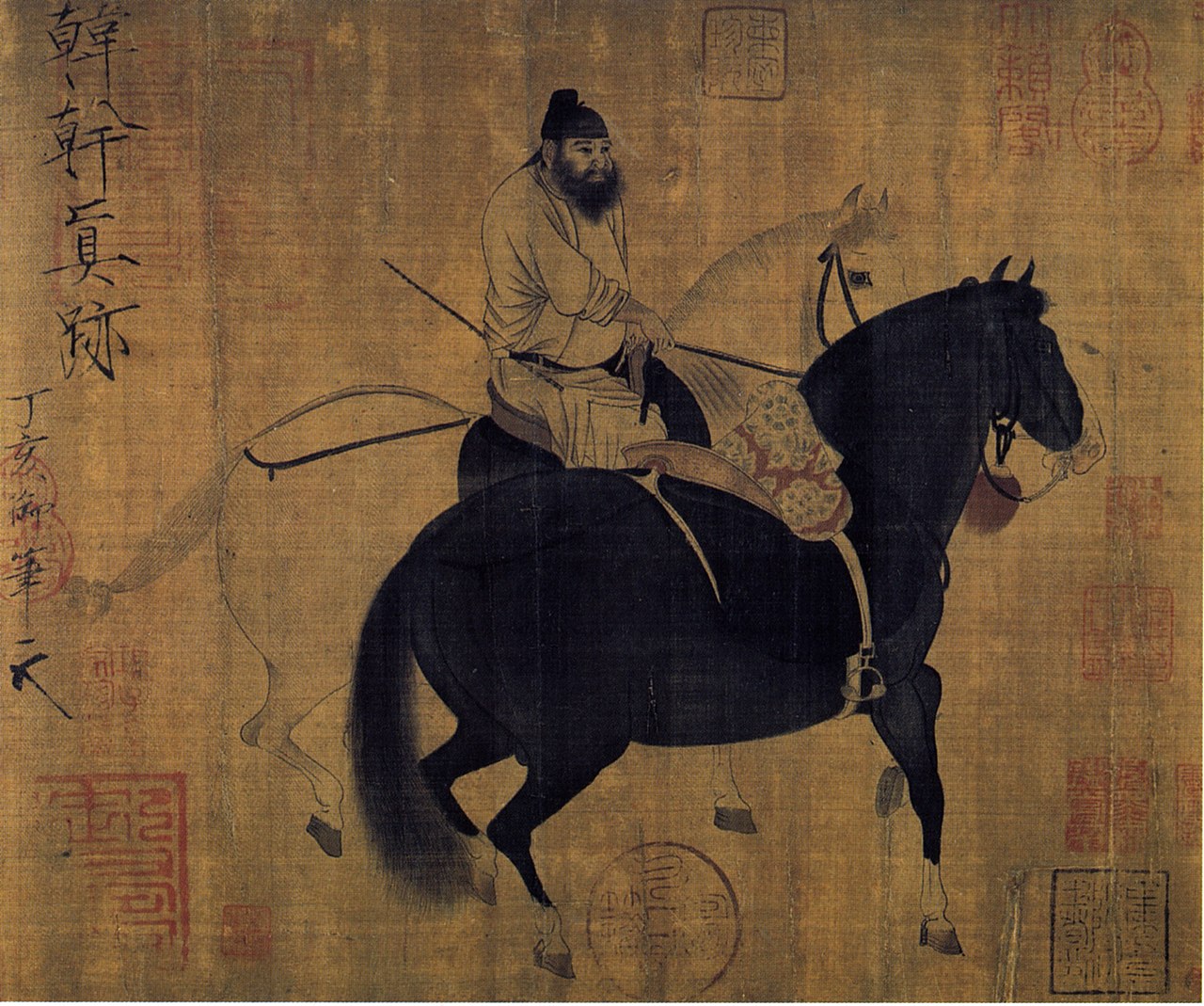
Han Gan (c. 706–783) was the supreme horse painter of the Tang dynasty — the stable-hand prodigy whom Wang Wei discovered and the imperial stables made immortal. His horses were painted, he said, from the horses themselves, and his era agreed that he captured not their likeness but their spirit. Of his great body of work only copies survive, but those copies — above all the Herdsman and Horses in the Palace Museum — remain among the most beloved images in Chinese art.
The Stable Boy Discovered
Han Gan’s origins were as humble as his fame became exalted. The records disagree on whether he was born in Chang’an, in Lantian nearby, or in Daliang (Kaifeng), but agree on the essential fact: he was poor, and he worked with horses — by the account of the Tang painting critic Zhang Yanyuan, in the very stables of the capital. His gift was discovered by Wang Wei, the poet-painter, who encountered the young groom’s drawings, recognized genius in them, and sponsored his training. Han became the student of Cao Ba, the celebrated court painter and horse specialist — himself the subject of Du Fu’s famous ballad — and within a generation the pupil surpassed the master.
The Emperor’s Horses
Under Emperor Xuanzong, whose court elevated every art it touched, Han Gan was appointed to the imperial academy and given what the era considered the ultimate commission and the ultimate vantage: the emperor’s own stables, where the Ferghana and steppe horses — the “thousand-li horses” of the dynasty’s cavalry prestige — were kept in hundreds. His method became legend. Asked why his horses differed from every predecessor’s, he replied that the palace stables were his teachers: he had studied the horses themselves, not old paintings. The great critic of the day, writing not long after Han’s death, described the result in terms that became the classical verdict: previous masters had painted the horse’s body, but Han Gan painted its spirit — the fire in the eye, the arrogance in the neck, the animal as a living presence on the silk. His horses were not portraits of horses; they were portraits of what horses meant to the Tang — power, breeding, empire, and beauty in one image.
Style and Survival
The surviving works associated with Han Gan — the Herdsman and Horses scroll in Beijing’s Palace Museum, the Night-Shining White in New York’s Metropolitan Museum — are copies or close later versions of lost originals, the originals having perished with the Tang. They show what the tradition treasured: heavy, muscular animals modeled in fine flowing lines, monumental against minimal ground, each horse a study in individual character. His fame outlasted his dynasty. The Five Dynasties painters studied him; the Song academicians copied him; the Ming and Qing connoisseurs argued over his autograph works with the fervor of theologians; and the Japanese collectors of the Nara era preserved attributions that carried his name across East Asia. Du Mu, writing within decades of his death, could already call him simply the greatest horse painter who had ever lived.
Historical Assessment
Han Gan matters beyond art history for what his career proves about the Tang. A stable boy could become the court’s supreme painter on the strength of talent alone — sponsored by the greatest poet of the age, trained by the reigning master, employed by the emperor himself — and the dynasty regarded this as normal. The openness of Tang cultural institutions to raw ability, paralleling the army’s openness to ability of any origin, is the social fact beneath the golden age’s golden surface. Han Gan’s horses are the image of the Tang at its most confident: magnificent, foreign-blooded, individual, and entirely unafraid.
References & Historical Sources
- Zhang Yanyuan, Lidai Minghua Ji (Record of Famous Painters of All Dynasties, c. 847), the primary account of Han Gan’s life and method.
- Zhu Jingxuan, Tangchao Minghua Lu (Famous Painters of the Tang Dynasty).
- Du Fu, “Ballad of the Painting of a Horse by Cao Ba” (the master Han Gan surpassed).
- Wen C. Fong et al., Beyond Representation (1992), on the surviving Han Gan attributions.