Dou Jiande
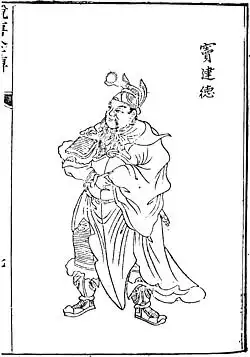
Dou Jiande (573 – 3 August 621) was the most admired of the rebel leaders who rose against the collapsing Sui dynasty. A farmer-soldier from Hebei, he built a disciplined and genuinely humane state — the Xia — that ruled the northeastern plain for five years, won the loyalty of gentry and peasant alike, and fell in a single afternoon at the Battle of Hulao against Li Shimin. The histories of the Tang, his destroyers, could not bring themselves to hate him: his is the rare rebel biography written with open respect.
From Farmer to Rebel King
Dou Jiande came from Zhangnan in Hebei, a man of the soil with local repute for generosity and nerve — in his youth he had once, unarmed, faced down bandits to save a companion. When the Sui’s Grand Canal corvée and the Korean campaigns broke the countryside in 611, the Hebei plain rose in revolt, and Dou’s neighbors made him their leader for exactly those qualities. His rise was methodical rather than meteoric: he defeated the butcher-bandit Zhang Jincheng, absorbed other rebel bands, took Yu Prefecture in 617 and proclaimed the Prince of Changle, then the Prince of Xia. By 619 his Xia state controlled most of Hebei — the richest agricultural region of the north — and Dou governed it with a care the Sui had long abandoned.
The Humane State
What distinguished the Xia from every other regime of the interregnum was governance. Dou Jiande lived plainly, took no palace luxury, held court in the open where petitioners could approach him, and enforced three rules his enemies conceded: no looting, no killing of prisoners, and honest administration. Officials were chosen for merit; taxes were light; the granaries were opened in famine. The Old Book of Tang, in the biography written after the Tang destroyed him, records that his soldiers did not dare pick fruit from orchards on the march, and that people fled other warlords’ territories to enter his. He acquired an advisor class of displaced Sui gentry — Pei Ju, the former Sui court minister, served him, as did the scholar Kong Deshao — and ran the Xia like a state, not a camp. When the Sui regicide Yuwen Huoji straggled into Hebei in 619 with the murdered emperor’s guard, Dou destroyed him and treated the Jiangdu captives with ceremony, winning enormous prestige among Sui-loyal elites.
Hulao
His end came from loyalty, not folly. In 621 the Tang prince Li Shimin besieged Wang Shichong’s Zheng state at Luoyang, and Dou faced the choice every Chinese strategist since has recognized as fatal either way: stand aside and watch Tang swallow the east, or march to save his enemy’s enemy. His strategist Ling Jing and his wife, Empress Cao, both argued the former — that holding the Hangu and Hulao passes and raiding the Tang rear would win the war without battle. Dou refused to abandon an ally, crossed into Henan, and offered battle at Hulao Pass on 28 May 621. Li Shimin, outnumbered, held the pass, exhausted the Xia army in the summer heat, and then attacked across the Sishui at the moment of Dou’s midday rest — the classic Taizong combination of patience and violence. The Xia army collapsed in hours; Dou Jiande, wounded, was captured alive.
The Execution and Its Aftermath
Li Shimin received his prisoner with respect — the two men were near the same age, and the victor’s court already sensed the conqueror’s unease — and sent him to Chang’an. Emperor Gaozu ordered his execution on 3 August 621. It was, even by the Tang’s own reckoning, a mistake the empire paid for: Dou’s Hebei rose at once under his old general Liu Heita, who in two years of war recovered the entire Xia territory before the Tang finally crushed him in 623. The Old Book of Tang’s authors, writing for the dynasty that had killed him, still record that the people of Hebei mourned Dou for generations — that his grave drew offerings a century later. It is the only such tribute paid to any rebel of the age.
Historical Assessment
Dou Jiande’s career poses the counterfactual that haunts the Tang’s founding: had he stayed behind his passes in 621, the Xia state — stable, solvent, and loved — might have been the empire’s northern half for decades, and Li Shimin’s reputation would be the story of a siege that failed. His defeat made him instead the perfect loser: the good king whose one act of faith destroyed him, a figure the Tang could honor precisely because it had killed him. Chinese historiography has kept him ever since as the standard of what a rebel could be when the rebellion had a conscience.
References & Historical Sources
- Old Book of Tang, biography of Dou Jiande; annals of Gaozu.
- New Book of Tang, biography of Dou Jiande.
- Zizhi Tongjian, volumes 186–189.