Chancellors & Statesmen
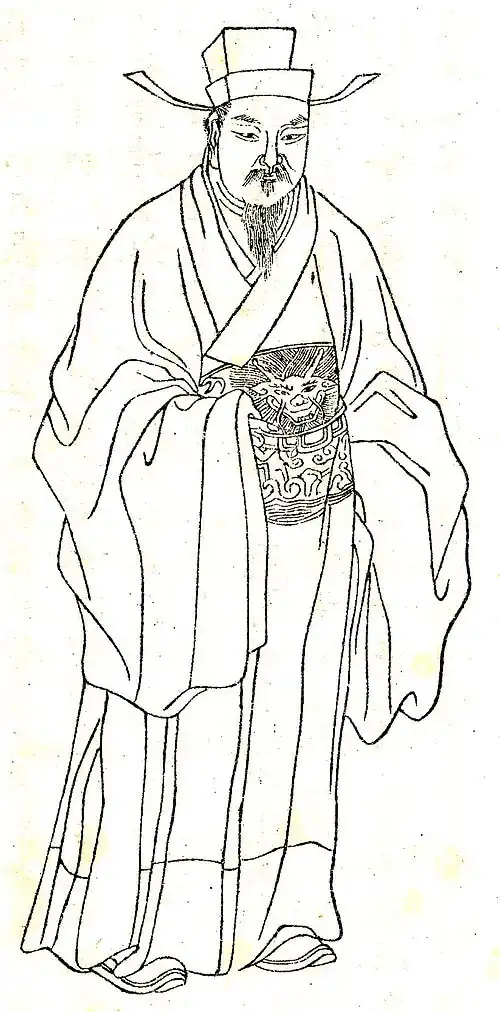
The Tang chancellorship was not a single office but a circle of trust at the top of government — the senior men of the Secretariat, Chancellery, and Department of State Affairs whom the emperor charged with drafting, reviewing, and executing policy. Some chancellors built the early empire's institutions; some kept the court honest; some destroyed rivals and poisoned the well of governance. This page surveys the men who held the dynasty's highest civil office, the powers they wielded, and the price of the job.
The Office and Its Power
Tang executive government was deliberately plural. The Grand Chancellor (zai xiang) was the collective designation of the chief ministers — sometimes one man, more often three to five, deliberating at the Polity Hall (Zhengshi tang) with the emperor or, increasingly as the dynasty aged, among themselves. From this arrangement came both the system’s strength (no single minister could rival the throne) and its vulnerability (a dominant personality could turn the plural chancellorship into a personal machine). The chancellor’s instruments were the memorial system, the drafting of edicts, and — decisively — the recommendation of officials. Because appointments flowed through the chancellor’s endorsement, control of the chancellorship meant control of the bureaucracy’s arteries.
The Great Early Chancellors
The founding generation set the pattern. Pei Ji planned the Taiyuan uprising with Li Yuan and served as the dynasty’s first chancellor; Fang Xuanling and Du Ruhui, Taizong’s celebrated pair (Fang the visionary planner, Du the decisive judge), administered the Zhenguan government that became China’s model of good rule, and their biographies head the Old Book of Tang’s ministerial chapters. Yao Chong and Song Jing, the two great chancellors of Xuanzong’s early Kaiyuan era, between them stabilized the post-Wu court, cleaned up its lawless favorites, and managed the bureaucracy with such rigor that the Zizhi Tongjian gives them much of the credit for the era’s prosperity. The mid-eighth century paired the upright, literary Zhang Jiuling — whose honesty famously included warning Xuanzong to his face that An Lushan would surely rebel — with the supple administrative reformer Pei Yaoqing, until the pair was displaced.
The Chancellorship as Trap
The office consumed its holders. The histories count more than 360 Tang chancellors, and a startling fraction of them died in exile, were executed, or were forced into suicide — the casualty rate rising steeply in the dynasty’s last century, when eunuchs and warlords, not examinations and memorials, decided who governed. Shangguan Wan’er, though never formally chancellor, held the drafting power of one under two regimes and died in a coup at forty-six. Hou Junji, a soldier elevated to the chancellorship for his conquests, traded it for a place on a scaffold in 643. Li Linfu held the office longer than anyone of his century and died in it — and thereby hangs the darkest of the dynasty’s lessons: the system could not always distinguish the servant of the state from its termite.
Chancellors and the Dynasty’s Turning Points
Reading the succession of chancellors is reading the dynasty’s biography. The reforming chancellors of the 780s — Yang Yan, architect of the Two-Tax Reform, and Lu Zhi, whose memorials on principle and remonstrance became Confucian classics — rebuilt the fiscal state after An Lushan. The late eighth and ninth centuries saw the great monetary chancellors Liu Yan and Yang Guozhong, the latter history’s most famous proof that an imperial favorite in the chancellorship is a fuse. Under Wuzong, Li Deyu directed the suppression of Buddhism and the defeat of the warlords; under the late emperors, chancellorships rotated so fast that the office became a holding pen. When the end came in 907, the chancellors of Tang signed the abdication edict that ended their dynasty — as chancellors had signed abdications before, and would again.
References & Historical Sources
- Old Book of Tang and New Book of Tang, biographies of Fang Xuanling, Du Ruhui, Yao Chong, Song Jing, Zhang Jiuling, Li Linfu, and Li Deyu.
- Zizhi Tongjian, annals of the Zhenguan and Kaiyuan eras.
- Robert des Rotours, Le traité des examens (1932), on the examination backgrounds of Tang chancellors.