An Lushan
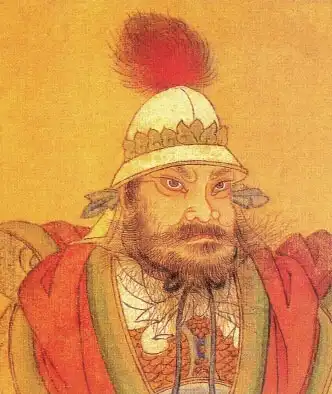
An Lushan (703 – 29 January 757) was the Sogdian-Turkic frontier general whose rebellion in 755 came within sight of destroying the Tang dynasty and, in the attempt, transformed China. Favorite of Emperor Xuanzong, commander of three of the empire's great military provinces, he proclaimed himself emperor of a new Yan dynasty and held both capitals — until his own son had him murdered in his palace. His name became the byword for treason in the Chinese language, and his rebellion the dividing line between the Tang's golden age and its long decline.
Origins and Rise
His origins were the frontier’s. Probably born in 703 to a Sogdian father and a Turkic mother of the Ashina clan, raised in the multi-ethnic military society of the northeast — he spoke several frontier languages and, by the histories’ mocking account, initially little Chinese — An Lushan made his career the way the northeast rewarded men: as a brave, cunning, illiterate-in-Chinese soldier in the endless wars against the Khitans and Xi. His talents — personal magnetism, cavalry craft, and above all the ability to make every superior and every court patron believe in his devotion — carried him from border raider to officer to the special favor of two men: the chancellor Li Linfu, who championed the policy of entrusting great commands to non-Han professionals, and the emperor himself. By the late 740s An Lushan was military governor of Pinglu; by 751 he held Fanyang and Hedong as well — three of the Tang’s ten military provinces, perhaps 150,000 of its best troops, commanding the entire northeastern frontier from the sea to the steppe.
The Favorite at Court
His visits to Chang’an became legend, and the histories record them with the relish of men describing a portent. Obese to the point of comic — he joked about his own bulk, and the court laughed — he performed the roles the aging Xuanzong’s court demanded: the jolly barbarian general, the adoptive son of the consort Yang Guifei (younger than he was), the loyal servant whose only request was to keep the emperor entertained and the frontier safe. He was rewarded beyond precedent: the title of prince, luxury beyond the law’s allowance for officials, and the emperor’s refusal to credit any word against him — not from Zhang Jiuling, who had warned as early as the 730s that this man would rebel; not from Yang Guozhong, Li Linfu’s successor as chancellor, whose feud with An Lushan became the court’s central tension from 753. Whether An planned treason for years, as the standard accounts insist, or was driven to it by Yang Guozhong’s provocations and the closing of every other option, is a question historians still debate; what is certain is that by 755 the three northeastern provinces were his in everything but name, and the court had no plan for the day he stopped pretending.
The Rebellion
On 16 December 755, An Lushan rose at Fanyang with a stated cause of marching against Yang Guozhong and a hidden one of taking the throne. The northeastern defenses, denuded by the court’s own misjudgments and the execution of its best generals, collapsed; the Grand Canal’s grain fleets burned; Luoyang fell in January 756, and there An proclaimed the Yan dynasty. Xuanzong abandoned Chang’an that summer; on the road to Sichuan his mutinous guard killed Yang Guozhong and strangled Yang Guifei at Mawei, the scene that poets made immortal. Chang’an fell unresisting. The old emperor’s son, the future Emperor Suzong, raised the standard of resistance at Lingzhou, and the war — fought by Guo Ziyi, Li Guangbi, and armies stiffened with Uyghur cavalry — slowly turned. An Lushan, gout-blind, raging, and paranoid in his Luoyang palace, lashed his attendants; on the night of 29 January 757 his own son An Qingxu, with a palace eunuch, cut his throat. His body was buried secretly in a mattress; the Yan dynasty he founded staggered on under his son and then under Shi Siming until 763.
Historical Assessment
The rebellion’s toll is the largest single figure in Tang demography: the census of 755 counted about 53 million people; that of 764 counted about 17 million — a drop that blends real death, displacement, and flight beyond registration, but that contemporaries experienced as the emptying of the north. The dynasty survived, transformed: the equal-field fiscal system collapsed, the northeast became hereditary warlord territory, eunuch power over the palace army began, and the economic center of gravity passed permanently south of the Yangzi. An Lushan’s personal responsibility was real but not solitary — the system that armed him, the favorite-making court that blinded itself, and the purge of the capitals’ best generals in 756 were the dynasty’s own work, and its historians, compiling under descendants of the emperor he nearly overthrew, needed a villain to carry the blame. He has carried it ever since: in Chinese, “An Lushan” remains, a thousand years on, a name a child learns as the very definition of the traitor.
References & Historical Sources
- Old Book of Tang, annals of Xuanzong and Suzong; biographies of An Lushan and Yang Guozhong.
- New Book of Tang, biography of An Lushan.
- Zizhi Tongjian, volumes 217–220.
- Edwin G. Pulleyblank, The Background of the Rebellion of An Lu-shan (1955).