Trade & Maritime Commerce
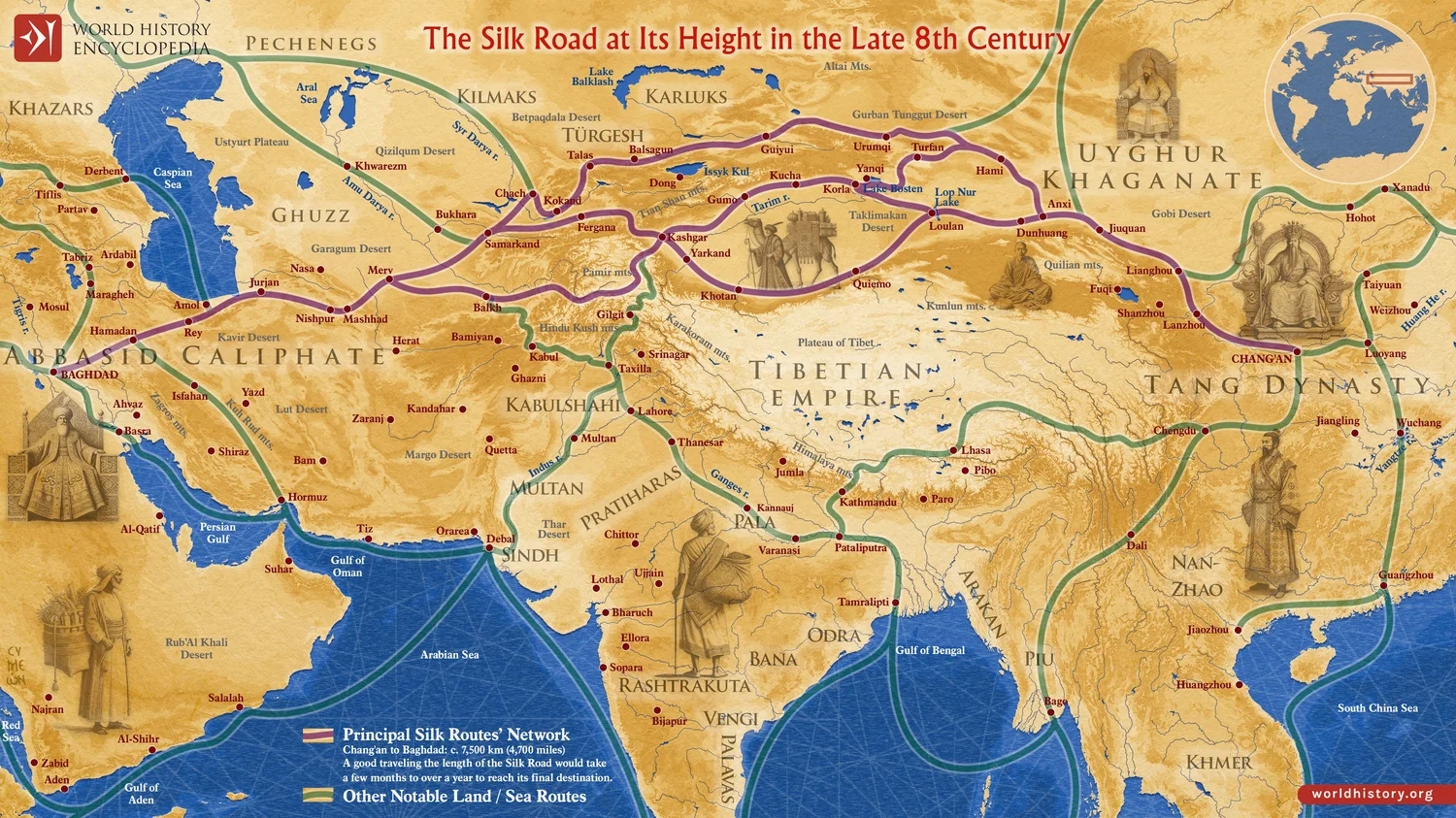
The Tang was the most connected empire of the early medieval world. Along the Silk Road through its western protectorates, down the Grand Canal into the Yangzi delta, and out from the great seaports of Guangzhou, Yangzhou, and later Mingzhou, Chinese silk and porcelain moved west while horses, glass, gems, spices, and ideas moved east. Tang customs receipts, foreign quarters, and merchant law reveal a state that taxed, licensed, and protected long-distance trade to a degree unmatched anywhere else in the eighth century.
The Two Arteries
Tang trade ran on a dual geography. The overland route — the Silk Road proper — threaded from the capitals through the Gansu corridor to the four garrison commands of the Western Regions (the Anxi Protectorate, headquartered at Qiuci/Kucha), thence across the Pamirs to Sogdiana, Persia, and the caliphate. The maritime route ran from Guangzhou (Canton) through the South China Sea to the Straits of Malacca, Sri Lanka, and the Persian Gulf, largely in the hands of Persian, Arab, and Indian shipping, though Chinese vessels grew increasingly ambitious by the ninth century. The two met at the Tang frontier: Sogdian caravans delivered central Asian goods to Chang’an’s western market, while Gulf dhows unloaded at Guangzhou’s foreign quarter, and the empire profited from both.
The Western Market and the Sogdian Network
Chang’an’s two great market wards — the eastern and western markets — were among the largest commercial spaces in the world, each over a square kilometer, divided into walled lots by commodity, and regulated by market commissioners who posted official prices each midday. The western market was the hub of the western trade: Sogdian merchants, identifiable by their pointed caps and bearded faces in Tang art, dominated the caravan business, operating hostel networks (kezhan) along the whole route from Samarkand to the capital. The Tang protected the route with its armies — the Anxi garrisons existed partly to keep the corridor open — and foreign envoys and merchants were handled by the Court of State Ceremonial (Honglu si) and, by the eighth century, by specially appointed commissioners. Horses were the strategic import of the age: steppe horses from the Turks and Uyghurs bought with silk were the fuel of Tang cavalry, and the horse-silk exchange was effectively state-managed trade policy.
Maritime Commerce and the Foreign Quarters
Guangzhou was the great southern entrepôt. By the Tang period it held a large foreign quarter — in Arabic sources a walled city within the city — of Arab and Persian merchants, served by its own religious buildings (the first mosques in China date from this era), and supervised by a customs commissioner whose staff measured and taxed incoming cargoes. Arab geographers of the ninth century (Ibn Khurradādhbih, Abu Zayd al-Sirafi) describe the Guangzhou trade in detail: Chinese exports of silk, porcelain, and paper for aromatics, pearls, ivory, rhinoceros horn, and medicinals. The reign of Emperor Suzong and his successors was a golden age of this trade; the Huang Chao rebellion’s sack of Guangzhou in 879, in which Abu Zayd records the killing of tens of thousands of foreign merchants — Muslim, Jewish, Christian, and Zoroastrian — dealt it a blow from which, combined with the An Lushan rebellion’s disruption of the overland route, the maritime economy recovered only slowly. Yangzhou, the canal metropolis, was the other great hub, where Persian and Arab merchants concentrated until the rebellion of 760 devastated its foreign community.
State Management and Revenue
The Tang did not practice free trade; it practiced managed trade, and managed it lucratively. Customs duties, market taxes, monopoly sales, and transit levies flowed to a treasury increasingly dependent on commercial revenue after 755. The salt monopoly, directed from 758 by the fiscal commissioner Diwu Qi and later perfected by Liu Yan, converted an everyday commodity into the dynasty’s fiscal backbone. Tribute and gift exchange — foreign missions bearing “tribute” and receiving imperial gifts of far greater value — formed a parallel, ceremonial trade the state used to rank and reward its neighbors; the New Book of Tang’s account of the Japanese missions, Silla embassies, and Caliphal envoys shows a court that understood diplomacy and commerce as one system.
Trade and Cultural Exchange
Goods traveled with ideas. Along the caravan roads and sea lanes came the three great faiths that transformed Tang civilization — Buddhism from India via the oases, Zoroastrianism, Nestorian Christianity (the Xian stele of 781 records a Persian church flourishing at the capital), Manichaeism, and Islam. Grapes, alfalfa, the pipa lute, and the game of polo arrived with the horses; glassware and silverwork brought Sasanian techniques into Chinese workshops, and Chinese porcelain in turn has been excavated from the Persian Gulf to East Africa. The Tang trade system was, in the fullest sense, the circulatory system of a world economy centered on China.
References & Historical Sources
- Old Book of Tang and New Book of Tang, treatise on food and money; monographs on foreign peoples.
- Abu Zayd al-Sirafi, Accounts of China and India, and Ibn Khurradādhbih, Book of Routes and Provinces.
- Edward H. Schafer, The Golden Peaches of Samarkand (1963).
- Philip D. Curtin, Cross-Cultural Trade in World History (1984), chapter on Tang trade.