The Silk Road in the Tang Dynasty
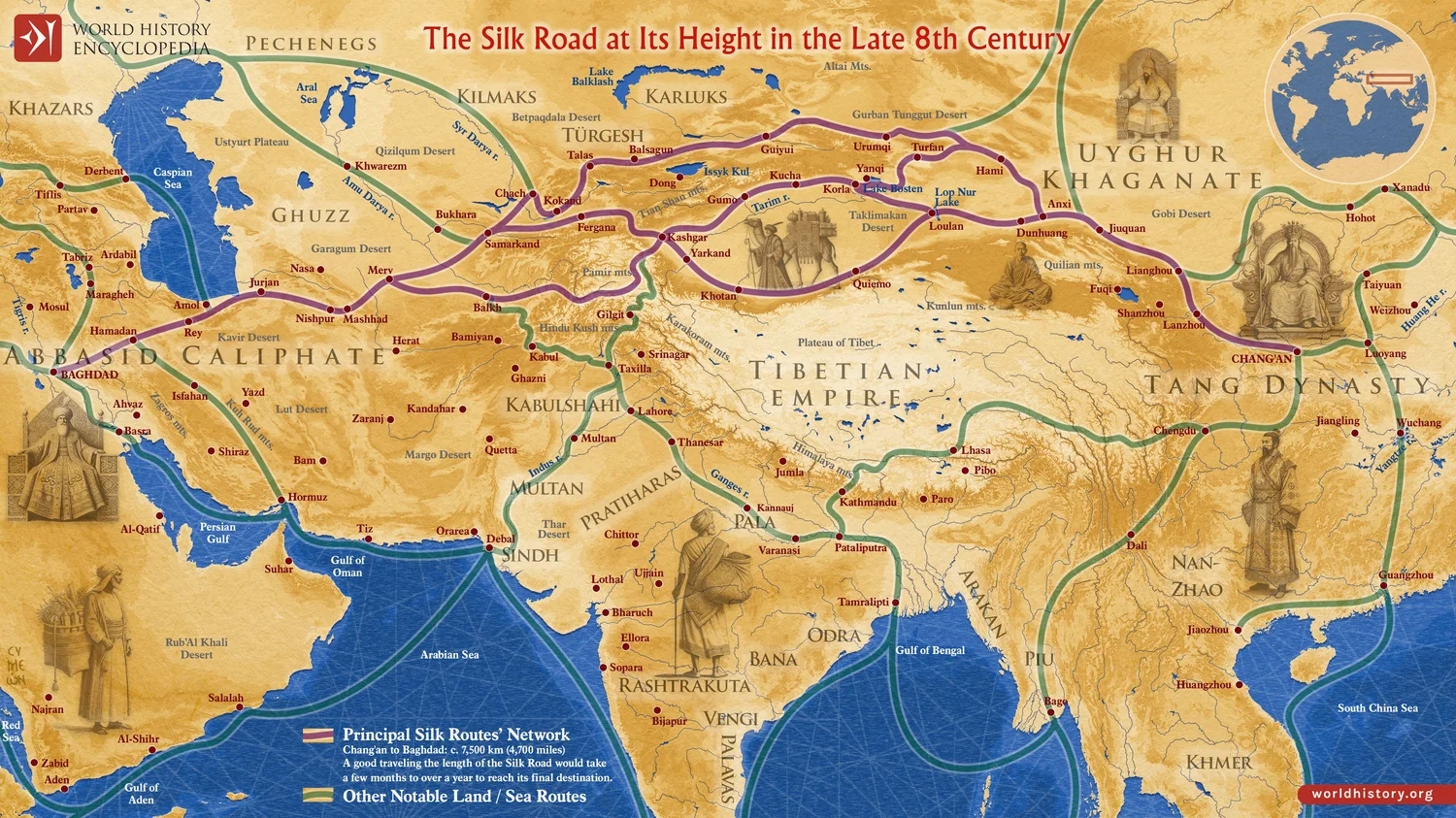
The Silk Road was never a single road but a shifting lattice of caravan tracks, mountain passes, oasis markets, and sea lanes binding China to Central Asia, Persia, India, and the Mediterranean world. Under the Tang, that lattice reached its greatest extent and greatest profit. Tang armies held the Gansu corridor and the oasis states beyond it, Tang coin and silk moved as far as Byzantium and Baghdad, and the caravanserais of Chang'an housed Sogdian, Persian, Arab, and Indian merchants by the thousand. The Tang did not merely use the Silk Road; for a century, it policed it, taxed it, and defined it.
From Han Foundation to Tang Apogee
The route was opened by the Han: Zhang Qian’s missions to Central Asia (138–115 BCE) mapped the western regions, and the Han Protectorate of the Western Regions (60 BCE) anchored the corridor. Six centuries of turbulence — the collapse of the Han, the rise and fall of steppe empires, the division of north and south China — kept the road intermittent until the Sui and Tang reunifications. The decisive Tang achievement was military: between 630 and 660 Taizong and Gaozong destroyed the Eastern Turkic Khaganate and subdued the Tarim oasis states, and in 640 the empire established the Anxi Protectorate at Qiuci (Kucha), extended in 658 to cover the western regions as far as the Pamirs, with the Four Garrisons of Kucha, Khotan, Kashgar, and Karashahr holding the desert ring. For the first time in history, a single power’s writ ran from the Yellow River to the Jaxartes, and the caravan road had what it had always lacked: a guarantor.
What Moved Along the Road
The traffic was two-way and transformative. Westward went silk above all — the dynasty’s signature export, a fabric so valuable that the Romans had complained of the drain of gold for it a thousand years before — along with porcelain, paper (a technology that would remake the Islamic world), tea, lacquerware, and cast-iron technology. Eastward came the things China wanted and could not make: Ferghana and Turkic horses, the foundation of Tang cavalry power; jade from Khotan; lapis lazuli; pearls, coral, and amber; Sasanian silverwork and Roman glass that Chinese connoisseurs prized and imitated; camels (the Bactrian camel became the emblem animal of the road itself); grapes and alfalfa; and above all the aromatics, drugs, and spices of India and the Gulf that filled Tang pharmacopoeias and temples. Tang documents and the hoards excavated along the route — Sogdian contracts, Persian coins, Byzantine gold at Xi’an — let historians price this trade, and it was large: the great caravans ran to hundreds of camels, and a single customs season at the frontier posts could see tens of thousands of head of livestock and bales of goods registered.
The People of the Road
The road’s human infrastructure was the Sogdians. This Iranian-speaking people of the Zeravshan valley — Samarkand, Bukhara, and Panjikent — had built the caravan business of inner Asia by the fourth century, and under the Tang their colonies stretched the entire length of the route: every oasis town had its Sogdian quarter, and their hostel networks (the ancestor of the caravanserai) moved goods, credit, and letters with a reliability the Tang state itself admired. Sogdian was the lingua franca of the road — the word “silk” in many languages traveled through their tongues — and Sogdians served the Tang as translators, brokers, soldiers, and even generals (An Lushan and Shi Siming, the rebel leaders of 755, were both of Sogdian descent). Alongside them moved Turkic nomads providing horses and escorts; Persians, increasingly after the Arab conquest of the Sasanian Empire (651) sent aristocrats, scholars, and Zoroastrian refugees east; Indians bearing Buddhist sutras and astronomers; and the occasional Roman, Byzantine, or Arab envoy on the far western marches.
Religion on the Road
The caravans carried faiths as readily as freight, and the Tang’s famous religious pluralism was in large part a Silk Road phenomenon. Buddhism had traveled the road for five centuries before the Tang — the pilgrim Xuanzang made its most famous journey in reverse, traveling to India in 629 and returning in 645 with 657 Sanskrit texts — but the Tang centuries added Zoroastrian temples (Zoroastrianism was the Sasanian state cult and followed Persian merchants to Chang’an, where the court maintained a Zoroastrian chaplain), Nestorian Christianity (the Xian stele of 781 records a Persian church in the capital, its doctrine carried by merchants and missionaries along the road), Manichaeism (banned in China proper but strong in the Uyghur corridor), and the first mosques of Guangzhou and the northwest. The Tang policy of tolerance was pragmatic — the court taxed and registered the foreign faiths much as it taxed and registered the foreign merchants — but its result was unique: a single empire sheltering, for a time, the whole spectrum of Eurasian religion.
The An Lushan Rebellion and the Road’s Decline
The road’s Tang apogee ended with the An Lushan rebellion (755–763). The Tibetan Empire, exploiting Tang weakness, seized the Gansu corridor and cut the oasis protectorates off from China proper; the Four Garrisons held out in heroic isolation until the Uyghur Khaganate recovered the corridor in 792, and even then the road never fully recovered its old volume. The late Tang could no longer guarantee the passage; banditry, Tibetan raids, and the Uyghur tolls on the rebuilt route made overland trade dear, and commerce that could go by sea increasingly did. The final irony belongs to the road’s last great Tang customers: the Uyghurs, paid in silk for cavalry that saved the dynasty in 757 and 762, developed such a taste for the fabric that silk became their medium of exchange — the road’s signature commodity passing one last time from Chinese loom to steppe saddle, as the sea lanes took the future.
Historical Assessment
The Tang Silk Road was the high-water mark of pre-Mongol Eurasian exchange: more secure, more heavily trafficked, and more policed than the Han version, more peaceful than the age of the Mongol empire. Its cultural deposit — the Buddhism of East Asia, the arts of Tang Chang’an, the sciences that traveled in monks’ saddlebags — long outlasted its commercial primacy. When the road revived under the Mongols six centuries later, the caravans would find the oases older, the faiths changed, and the name by which we remember it — the “Silk Road,” coined by the geographer Ferdinand von Richthofen only in 1877 — not yet imagined.
References & Historical Sources
- Old Book of Tang and New Book of Tang, monographs on the Western Regions (Xiyu zhuan).
- Zizhi Tongjian, volumes on the 630–660 western campaigns.
- Abu Zayd al-Sirafi and Ibn Khurradādhbih, ninth-century Arabic geographic accounts.
- Xuanzang, Great Tang Records on the Western Regions (Da Tang Xiyu ji).
- Edward H. Schafer, The Golden Peaches of Samarkand (1963).
- Valerie Hansen, The Silk Road: A New History (2012).