Economic Systems
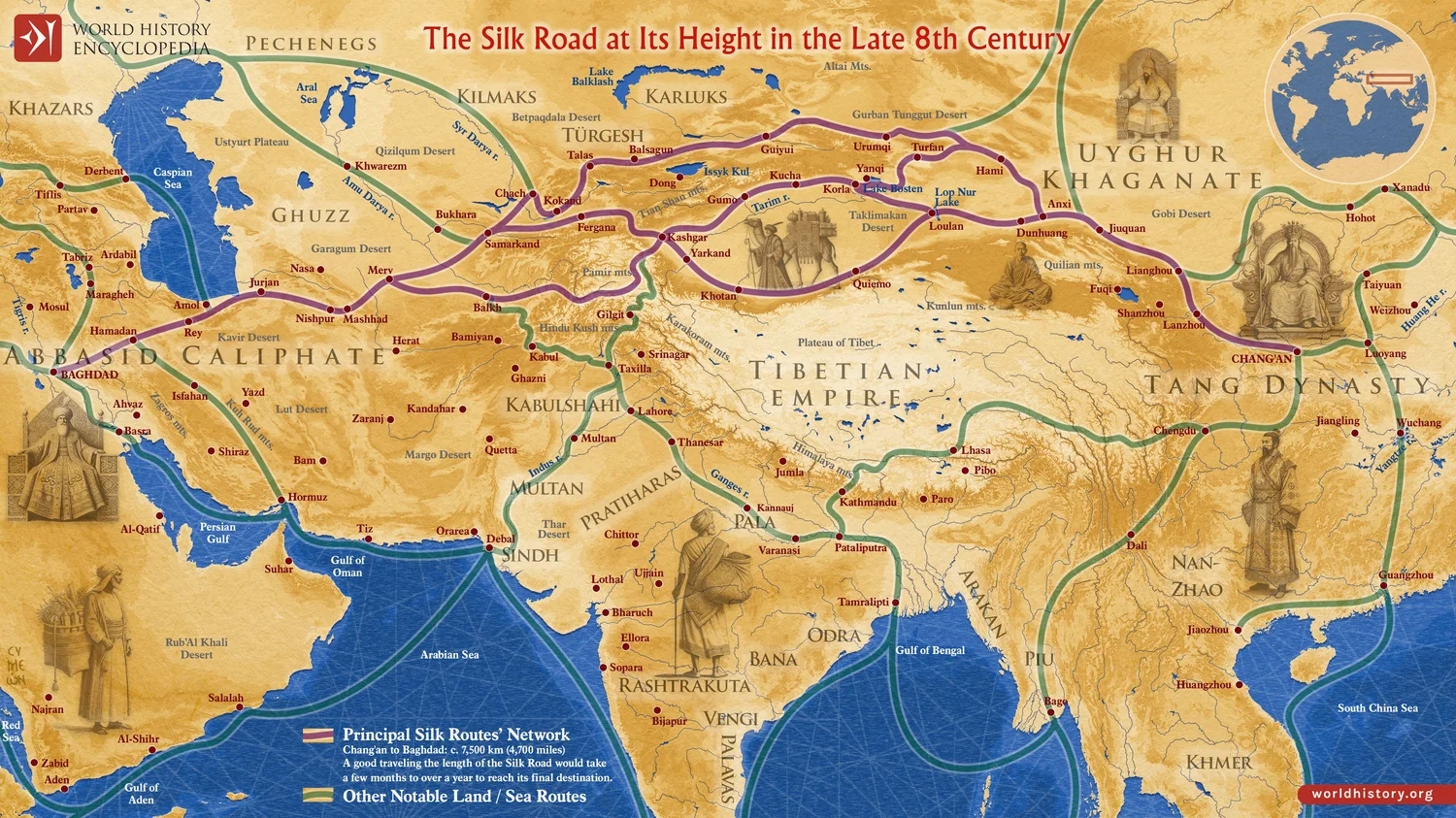
The Tang economy grew from a restored agrarian order into the most commercialized economy in the world, then broke apart and reassembled itself on entirely new fiscal foundations. Its story runs through four systems: the equal-field land allotment, the zu-yong-diao tax structure built on it, the state monopolies that increasingly replaced land tax as the government's lifeline, and the Two-Tax Reform of 780 that closed the old order and opened a commercial age.
Land: The Equal-Field System
The economic foundation of the early Tang was the equal-field system (juntian), inherited from the Northern Wei and refined under the Sui. Its premise was that the state owned the land and allotted it to households for life: roughly 100 mou (about 5.3 hectares) per adult male, of which a portion reverted to the state on the holder’s death and a portion could be inherited. In exchange for this allotment, the male peasant owed fixed obligations. The system served three purposes at once: it maximized cultivation of land devastated by the late-Sui wars, it tied labor to tax and military obligations, and it prevented the great estates of the aristocracy from swallowing the free peasantry — at least in theory. In practice, the allotment quotas were never fully met in densely populated regions, and from the dynasty’s second century powerful families, Buddhist monasteries, and frontier military colonies absorbed land on a growing scale.
Tax: The Zu-Yong-Diao Structure
On the land allotment rested the tripartite tax known by the names of its three components: zu (grain, about two shi of rice or millet per adult male), yong (cloth, twenty feet of silk or linen plus three ounces of silk floss or three jin of hemp per head), and diao (labor — twenty days per year, commutable into additional cloth). Because assessments were based on registered adult males rather than land, the whole structure depended on accurate census registers, and the early Tang registers were indeed remade with remarkable thoroughness: the census of 754 counted 52.9 million people in 8.9 million registered households. Two corollaries made the system humane by the standards of the time: unregistered vagrants could be settled under amnesty edicts (with exemptions), and disaster edicts routinely remitted taxes in stricken prefectures — the Old Book of Tang records hundreds of such remissions.
The Commercial Economy
Underneath the agrarian order, a commercial economy of great sophistication was growing. The capitals had designated market wards that functioned as regulated commodity exchanges, with price boards, quality inspectors, and state-licensed brokers (yaren); the greatest provincial cities — Yangzhou above all, “the city of wealth and splendor” in Tang verse — supported banking-like houses that developed early forms of the flying money (feiqian) remittance certificate, ancestor of paper money. The Grand Canal made the system cohere: each year hundreds of grain barges moved the tax rice of the southeast northward, and canal transport itself became a major state enterprise with its own commissioned administration. Foreign trade added another layer: at Guangzhou, the customs office under the eunuch commissioner was, by the ninth century, collecting duties estimated in Arabic sources at staggering sums.
The Great Fiscal Transformation
The An Lushan rebellion broke the old system faster than it broke the empire. Census registers collapsed as millions fled the war zone; the equal-field allotments, already eroded, ceased to be administered; and the central government, cut off from the northern tax base, survived on three expedients: emergency surtaxes, the salt monopoly, and southern revenue. The salt monopoly was the decisive instrument. From 758 the government monopolized salt production, selling to licensed merchants at a markup that at its peak supplied more than half of central revenue — a fiscal dependence the dynasty never escaped. In 780 the chief minister Yang Yan codified the settlement in the Two-Tax Reform (liangshui fa): henceforth tax was assessed on households according to property and on land according to acreage, collected twice yearly (hence “two taxes”), and payable in cash as well as kind. It abandoned the ancient principle of taxing persons in favor of taxing assets, acknowledged the primacy of land as wealth, and — by demanding cash — accelerated the commercialization of the whole economy. Versions of the two-tax principle structured Chinese fiscal policy for the following thousand years.
References & Historical Sources
- Old Book of Tang and New Book of Tang, treatises on food and money (Shihuo zhi).
- Zizhi Tongjian, volumes on the 780 reform.
- Denis Twitchett, Financial Administration under the T’ang Dynasty (1963), the foundational study.
- Twitchett, “The T’ang Market System” (Asia Major, 1966).