Central & Local Administration
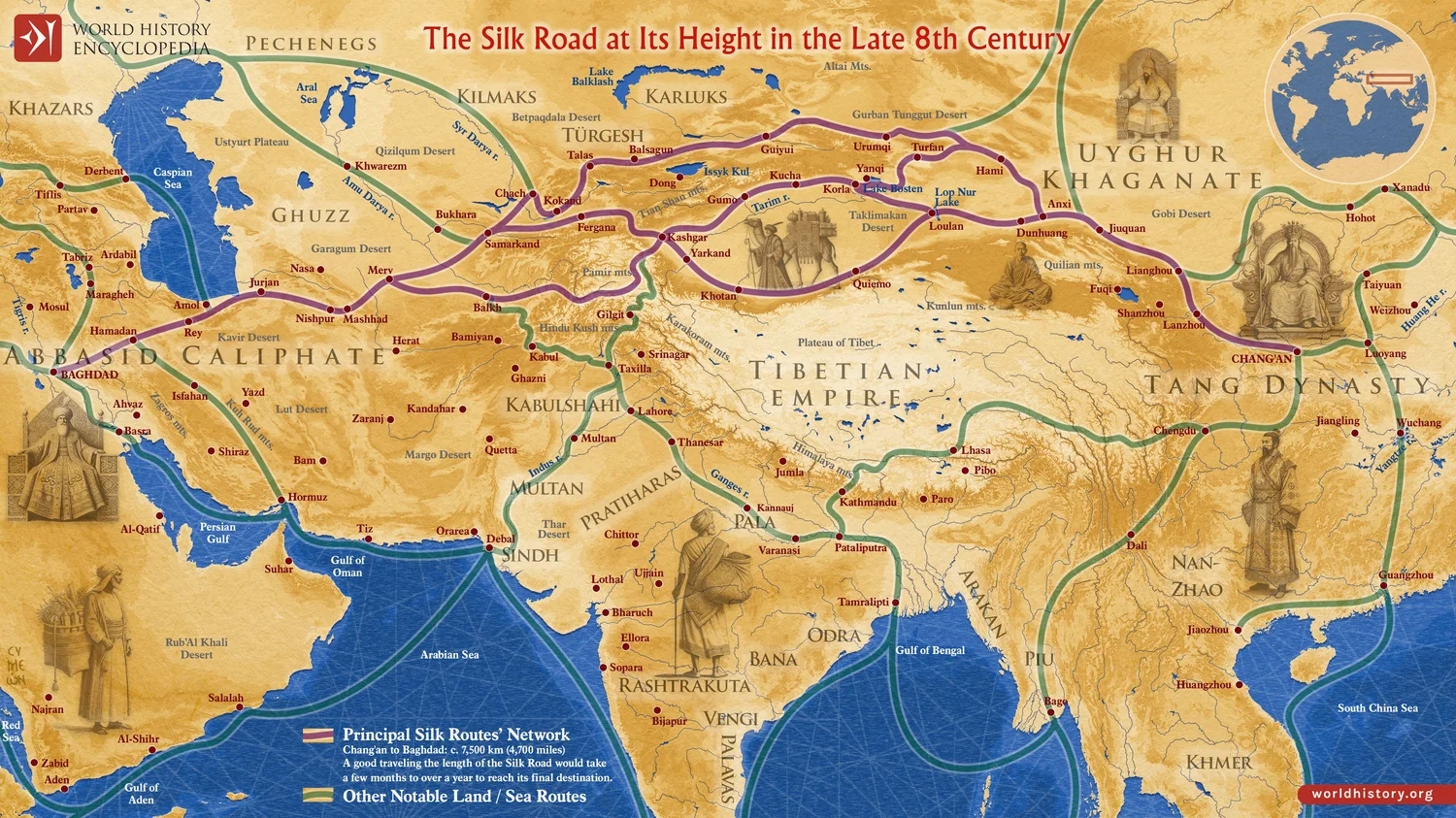
The Tang government was a pyramid: three departments and six ministries in the capital, ten (later more) inspection circuits in the provinces, roughly 300 prefectures, and over 1,500 counties, all staffed by a bureaucracy that mixed examination graduates, aristocratic heirs, and military men. This page explains how the machine was organized, who actually ran it, and how its balance of power between center and locality shifted over the dynasty's three centuries.
The Central Government
Authority at the top was deliberately divided to prevent any single minister from dominating the throne. The Secretariat (Zhongshu sheng) drafted policy, the Chancellery (Menxia sheng) reviewed and could return it, and the Department of State Affairs (Shangshu sheng) executed it through the Six Ministries: Personnel (selecting and evaluating officials), Revenue (registers, taxes, granaries), Rites (ritual, examinations, foreign tribute, the state cult), War (army administration, maps, dispatches — though not command in the field), Justice (review of sentences and the annual audit of penal matters), and Public Works (water control, construction, state workshops). The Grand Chancellor (zhaixiang or simply xiang) was not a single office but a designation held by the senior officials of these departments — sometimes one man, sometimes a group of four or five who deliberated collectively.
Two further organs checked the regular ministries: the Censorate (Yushi tai), whose investigating censors were empowered to impeach any official, memorialize against imperial policy, and tour the provinces; and the Hanlin Academy, founded under Xuanzong as a palace secretariat of literary men and scholars, which by mid-dynasty had become the true inner cabinet, drafting edicts and counseling the emperor outside the formal ministerial chain.
The Provincial Order
Local administration ran through a three-tier hierarchy. The circuit (dao) was originally a supervisory zone, not a government — an inspector sent from the capital toured its prefectures and reported on officials. Below it sat the prefecture (zhou, about 300, graded by size from over 40,000 households down to under 20,000), governed by a prefect (cishi) with a small staff of registrars, law officers, and revenue clerks. The county (xian, over 1,500) was the level where the state actually touched the population: registers were compiled there, taxes collected there, and justice administered there, by a county magistrate (xianling) whose competence was the single most important variable in the quality of Tang governance. The proverb that survives from the period — a good magistrate keeps the county quiet — reflects the reality that, for most Tang subjects, the empire was one man behind a desk in a county office.
Who Actually Governed
Recruitment ran through three broad channels: the examinations (jinshi degree increasingly prestigious, mingjing and other degrees more technical), hereditary privilege (yinyin, by which senior officials enrolled sons and grandsons directly), and recommendation. The Tang never abolished aristocracy; the great northeastern clans — the Lis of Zhaojun, the Zhengs of Xingyang, the Cuis of Boling — monopolized many of the highest posts well into the ninth century, and the examination lists show their dominance clearly. Yet the examination’s prestige grew steadily, and by the late Tang the jinshi degree had become the recognized ladder by which provincial gentry entered national politics. Empress Wu expanded the examination intake and added the palace examination as a deliberate counterweight to the clans, a policy later rulers continued.
The Fatal Shift: From Inspectors to Warlords
The early Tang’s provincial design contained a deliberate weakness: the circuits had no armies. Frontier defense was entrusted to area commands (zongguan fu, later jiedushi), and when, from the mid-eighth century, these commands were made permanent and their governors (jiedushi) gained control of local revenue and civil administration, the center began to lose the provinces. The An Lushan rebellion turned the flaw into the system: after 763, over forty military governorships held real power, the northeastern ones hereditary. The court retained the prosperous southeast and the prestige of legitimacy; much of the north was ruled by men the Old Book of Tang calls “half-rebel” — nominally Tang officials, functionally sovereign. Late Tang administrative history is the history of the court clawing back fiscal control (the salt monopoly, the two-tax reform) while conceding everything else.
References & Historical Sources
- Old Book of Tang, treatise on officials (Baiguan zhi); New Book of Tang, treatise on officials and selection.
- Du You, Tongdian, juan 19–40, on central and local organs.
- Robert des Rotours, Traité des fonctionnaires et Traité de l’armée (1947–48), translation and study of the New Book of Tang treatises.
- Denis Twitchett, Financial Administration under the T’ang Dynasty (1963), on the fiscal organs.