Kaiyuan Za Bao: The Court Bulletin
Circulated during the prosperous Kaiyuan reign (713–741) of Emperor Xuanzong, the …
The Tang dynasty (618–907) ran the largest and most sophisticated state on earth. Its government fused aristocratic tradition with meritocratic bureaucracy, its fiscal system fed and clothed perhaps eighty million people through a canal network without ancient parallel, and its laws became the model for all of East Asia. This section examines how the Tang was actually governed: the central ministries and the commanderies below them, the land and tax systems that underpinned the economy, the legal codes enforced from Chang'an to Guangzhou, the ideology that legitimized the throne, and the trade routes — overland and maritime — that connected the empire to the world.
At its height under Emperor Xuanzong (r. 712–756), the Tang administered a territory comparable to the Han at its greatest extent, from the oasis cities of the Tarim Basin to the Red River delta, and from Korea’s borders to the Pamirs. The central government in Chang’an divided authority among the three departments (sansi) — the Chancellery (reviewing), the Secretariat (drafting), and the Department of State Affairs (executing) — beneath which sat the Six Ministries: Personnel, Revenue, Rites, War, Justice, and Public Works. Below the ministries, the empire was mapped into circuits (dao), prefectures (zhou), and counties (xian), each with a graded quota of officials. The Old Book of Tang’s treatise on officialdom lists over 13,700 civil and military posts in the capital and provinces.
Three features set the Tang apart from its predecessors. First, the steady institutionalization of the examination system (keju), which, while still enrolling only a minority of officials — aristocratic recommendation and hereditary privilege (yinyin) remained powerful throughout the dynasty — gave the throne a lever against the great clans and seeded the scholar-official class that would dominate China for the next millennium. Second, the codification of law: the Tang Code (Tang lü shuyi), completed in 653 under Emperor Gaozong, was the most influential body of law in East Asian history, adopted and adapted by Japan, Korea, and Vietnam. Third, the fiscal-ecclesiastical synthesis: an agrarian tax system (the zu-yong-diao structure) based on the equal-field land allotment, designed in the Northern dynasties, matured under the early Tang and funded a century of low taxation and cheap government that contemporaries remembered as a golden age.
The Tang economy rested on agriculture — wheat and millet in the north, irrigated rice in the Yangzi delta — but its dynamism came from connection. The Grand Canal, inherited from the Sui and dredged and maintained by Tang engineering, moved southern rice north to feed the capitals and the frontier armies; the salt and iron monopolies, run through specially commissioned commissioners, supplied cash revenues that the land tax could not; and the empire’s cities — Chang’an, Luoyang, Yangzhou, Guangzhou — stood at both ends of the Silk Road and the maritime routes to India, Persia, and the Arab caliphate. Foreign merchants, Sogdian caravaneers, Arab shipmasters, and Japanese monks all appear in Tang records, testimony to a commercial openness rarely matched in later Chinese history.
After the An Lushan rebellion (755–763), the equal-field system collapsed in practice, the canal-fed fiscal machine seized up, and the government resorted to emergency expedients: salt monopoly profits, tea taxes, and eventually the great Two-Tax Reform of 780, which replaced the old per-capita levies with taxes assessed on property and acreage, payable in cash as well as kind. The late Tang state was leaner, more commercial, and more dependent on the southeast — a fiscal revolution that outlasted the dynasty itself.
Circulated during the prosperous Kaiyuan reign (713–741) of Emperor Xuanzong, the …
Stretching over 2,000 kilometers from the southern port of Hangzhou across the …
The Tang Code (Tanglü Shuyi, 唐律疏议) is the oldest surviving complete legal code in …
The Three Departments and Six Ministries (Sansheng Liubu, 三省六部) formed the central …
The Tang government was a pyramid: three departments and six ministries in the …
The Tang economy grew from a restored agrarian order into the most commercialized …

A Taishang Huang, or 'Supreme Emperor', was a living former sovereign who had, at …

Taoism was the Tang dynasty's state religion by design. The imperial house claimed …
The Tang monarchy sat at the center of a political cosmology older than the dynasty …
The Tang produced the most influential legal code in East Asian history. The Tang …
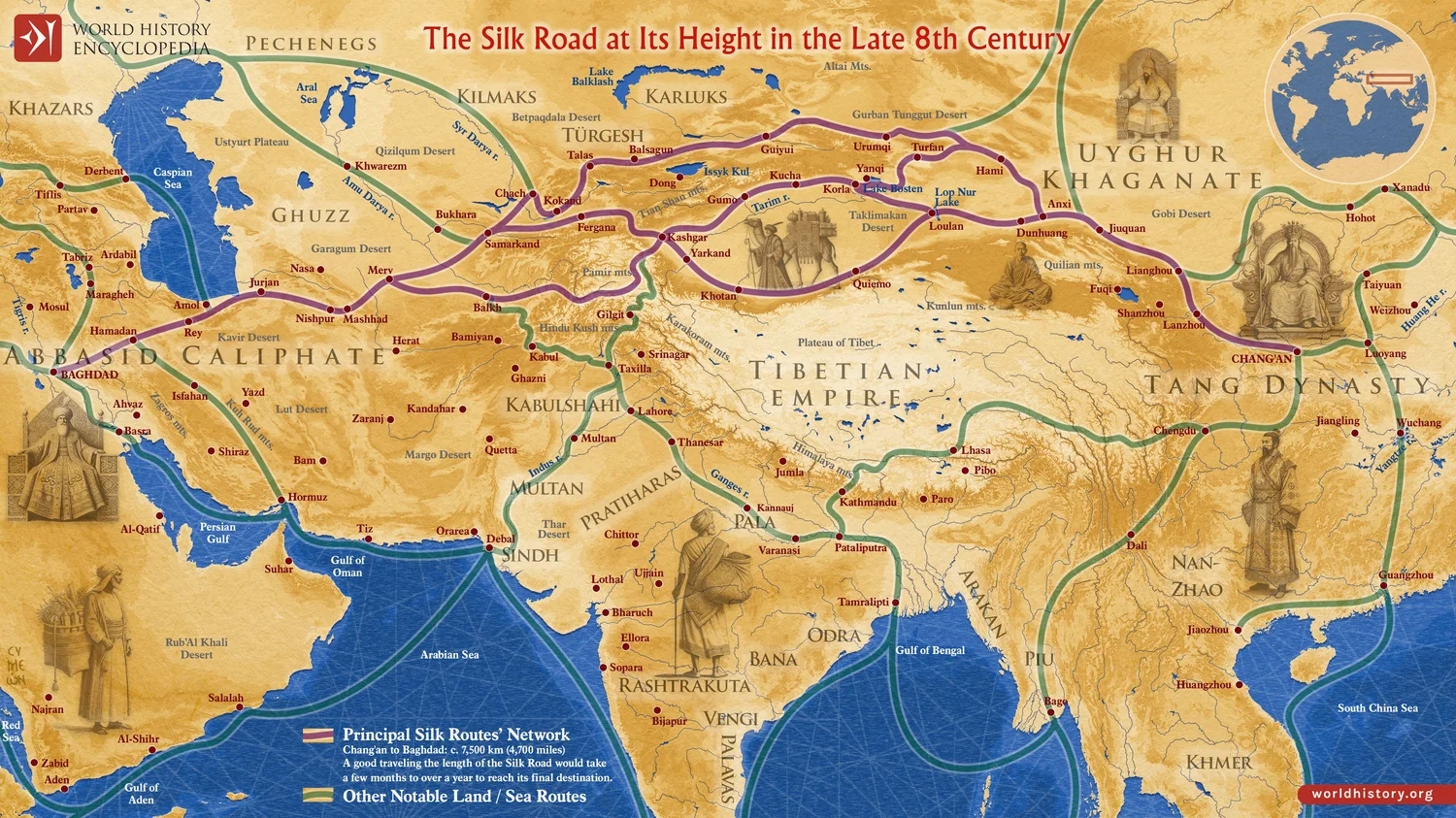
The Silk Road was never a single road but a shifting lattice of caravan tracks, …
The Tang was the most connected empire of the early medieval world. Along the Silk …