The Xuanwu Gate Incident (626)
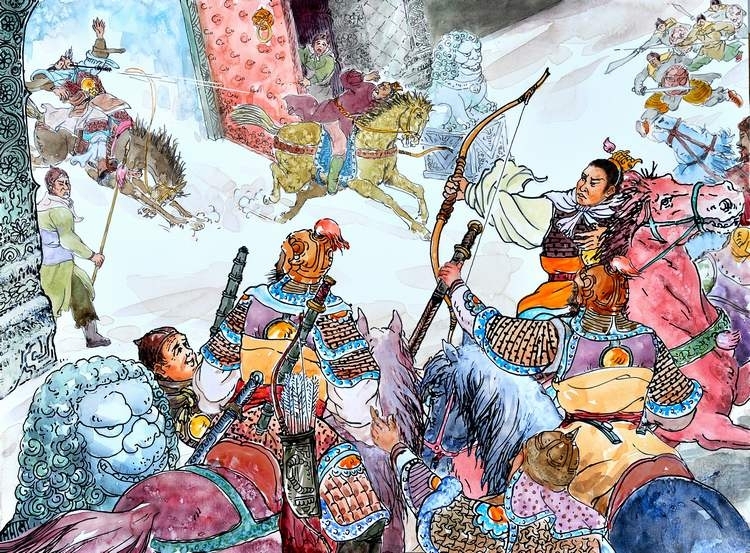
On the morning of July 2, 626, Li Shimin, second son of the founding emperor and Prince of Qin, ambushed and killed his elder brother, the crown prince Li Jiancheng, and his younger brother Li Yuanji, Prince of Qi, at Xuanwu Gate, the northern entrance to the Tang palace. Within days, Li Shimin was crown prince; within two months, he was emperor. The incident is the pivotal political event of the early Tang, and the way it has been remembered — and edited — tells us as much about Taizong's reign as the event itself.
The Succession Struggle
The roots of the confrontation lay in the structure of the dynasty’s founding. Li Yuan had risen in 617 with the military backing of his second son Li Shimin, whose campaigns destroyed Xue Ju, Liu Wuzhou, Wang Shichong, and Dou Jiande and effectively won the empire. Taizong’s entourage of generals — Yuchi Jingde, Qin Shubao, Cheng Yaojin, and others — was personally loyal to him, not to the throne. The eldest son Li Jiancheng, however, was crown prince by the principle of primogeniture, supported by the fourth son Li Yuanji and, crucially, by the traditional bureaucracy and palace establishment. By 626 both sides were arming; the Old Book of Tang records that the Jiancheng–Yuanji faction had maneuvered to strip many of Shimin’s officers from his staff and had allegedly poisoned him at a banquet — an accusation surviving only in pro-Qin sources.
The Ambush
On the morning of the fourth day of the sixth month of Wude 9 (July 2, 626), Li Jiancheng and Li Yuanji rode toward the palace to answer their father’s summons — in some accounts to answer accusations of illicit relations with the imperial concubines. At Xuanwu Gate, where Li Shimin’s troops had taken position during the night, the two were intercepted. Li Shimin shot and killed Li Jiancheng himself; Li Yuanji fled into the woods and was killed by Yuchi Jingde. Shimin’s men then entered the palace and, according to the official account, compelled the shaken Emperor Gaozu to name Shimin crown prince, with the “government and military orders henceforth to be decided first by the Prince.” Two months later Gaozu abdicated, and Li Shimin took the throne as Emperor Taizong.
Taizong’s Rewriting of History
What makes the incident uniquely sensitive is what happened to the record. Taizong, conscious that fratricide and forced abdication were the gravest breaches of filial and fraternal ethics, pressured the court historians to let him see the Veritable Records (shilu) of his father’s reign — a breach of a centuries-old taboo — and the surviving account of 626 is visibly shaped by the victors. Modern historians read the received narrative with systematic suspicion: Li Jiancheng appears as incompetent and dissolute, though he had in fact competently administered the capital region for years and won real support at court; his alleged plots read like retroactive justification. Even the date and choreography of the ambush are reconstructed almost entirely from sources finalized under Taizong himself.
Consequences for the Dynasty
The immediate consequence was an exceptionally capable reign — Taizong’s twenty-three years are conventionally the model of good government in Chinese political memory, and the Zhenguan era (627–649) set the Tang’s institutional template. But the precedent was poisonous. The Xuanwu Gate incident normalized the principle that military power could settle succession disputes, and the palace gates of Tang Chang’an saw armed succession violence again and again: in 705, 710, 713, and finally in the Sweet Dew Incident of 835. Taizong’s own example haunted the dynasty he built; his son Li Chengqian’s abortive coup attempt of 643, and the later coups that brought Zhongzong, Ruizong, and Xuanzong to power, all replayed in compressed form the logic of 626.
Historical Assessment
Traditional historiography, beginning with the Zizhi Tongjian, treats the incident as a tragic necessity: Jiancheng and Yuanji plotted first, and Taizong acted to save the state he had won. Modern scholarship stresses instead the victor’s control of the archive and reads the event as a palace coup whose justification was written afterward. Either way, the Xuanwu Gate incident is the founding violence of the Tang political order — the act from which the dynasty’s greatest age, and its chronic instability of succession, both descend.
References & Historical Sources
- Old Book of Tang, annals of Gaozu and Taizong; biographies of Li Jiancheng and Li Yuanji.
- New Book of Tang, annals of Taizong.
- Zizhi Tongjian, volume 191, the fullest continuous narrative of the incident.
- Howard J. Wechsler, “The Founding of the T’ang Dynasty” (in Cambridge History of China, vol. 3), on the politics of the founding brothers.