The Sui Dynasty: Unification and Overreach (581–618)
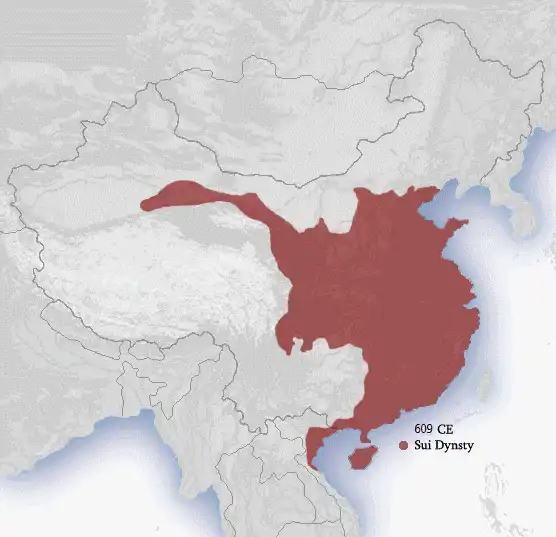
The Sui dynasty reunified China after nearly three centuries of division and built the Grand Canal, the examination system, and the administrative machinery that the Tang would inherit. Its founder ranks among China's great unifiers; his son ranks among its most infamous failures. Understanding the Sui is indispensable to understanding the Tang, which took over its institutions almost wholesale and made a public doctrine of learning from its mistakes.
Founding and Unification
Yang Jian, a general of mixed Chinese-Tuoba aristocratic background serving the Northern Zhou, seized the throne from his own grandson in 581 and founded the Sui, taking the reign title Wen. In 589 his armies swept south and conquered the Chen dynasty, reunifying China for the first time since the fall of the Western Jin in 316. Emperor Wen reformed administration, reduced taxes, extended the equal-field land system, and cracked down on the hereditary aristocracy’s privileges. His census of 606 registered some 46 million people in about 8.9 million households — evidence both of recovery and of the dynasty’s remarkable registration capacity. Peasants reportedly stored grain surpluses for years; the official histories claim that the state’s granaries were still feeding people decades after the dynasty fell.
Emperor Yang and Megaprojects
His son Yang Guang, Emperor Yang, succeeded in 604 — having, by the standard accounts, murdered his father to do so. His reign was defined by staggering ambition. He completed and extended the Grand Canal, linking the Yellow River and Huai systems with the Yangzi delta and Hangzhou in a single hydraulic artery over 1,700 kilometers long; he rebuilt Luoyang as the eastern capital on a monumental plan; he waged three disastrous campaigns against Goguryeo (612–614), each mobilizing over a million men; and he toured the south in immense flotillas. The Book of Sui estimates that over two million laborers worked on the canal and palaces, with mortality rates that the official historians describe as catastrophic. The fiscal and human strain detonated revolts across the north from 611 onward.
Collapse and the Transition to Tang
By 617 the dynasty was disintegrating: Li Mi and the Wagang army controlled the Henan grain routes, Dou Jiande held Hebei, Li Zitong and others rose in the south, and the Turks hovered on the northern frontier. In that year Li Yuan, Duke of Tang and Sui garrison commander at Taiyuan, rebelled with the connivance of his second son Li Shimin, marched on Chang’an, and installed a Sui child puppet before taking the throne himself as the first Tang emperor, Gaozu, in 618 — the very year Emperor Yang was strangled in a coup at Jiangdu (Yangzhou) by his own guards. Nearly all of the rebel contenders were then eliminated not by Sui loyalists but by the new Tang state within the next decade.
The Sui Legacy to the Tang
The Tang’s debt to the Sui was enormous and self-acknowledged. Emperor Taizong repeatedly cited Emperor Yang as the negative exemplar of his own governance. The Tang inherited: the three-department, six-ministry central government structure; the Grand Canal that fed the capitals; the equal-field and tax-grain-cloth fiscal system formalized by the Sui; the prefecture-county hierarchy; and above all the imperial examination (keju), first used under Emperor Wen and Yang, which in Tang hands became the great engine of social mobility. The Tang also inherited the Sui’s problems — overextended frontiers, a Goguryeo unfinished — and resolved them differently: Taizong’s failed campaign of 645 against Goguryeo was the direct echo of his predecessor’s, and the dynasty wisely let the goal go.
Historical Assessment
Historians conventionally contrast “good” Wen and “bad” Yang, but the division is partly a Tang-era historiographical construction designed to legitimize the new dynasty. Modern scholarship emphasizes that Emperor Yang’s projects — the canal above all — were rational, even visionary investments that the Tang profited from for three centuries; his failure was tempo, not vision. The Sui remains the classic Chinese case of a dynasty that achieved everything and thereby destroyed itself.
References & Historical Sources
- Book of Sui (Sui shu 隋書), compiled under Wei Zheng et al. in the early Tang, juan 1–4 for emperors Wen and Yang.
- Zizhi Tongjian (資治通鑑), volumes 175–185.
- Old Book of Tang and New Book of Tang, annals of Emperor Gaozu for the 617–618 transition.
- Arthur F. Wright, The Sui Dynasty (1978), the standard English monograph.