The Han Dynasty: The Empire the Tang Measured Itself Against (206 BCE–220 CE)
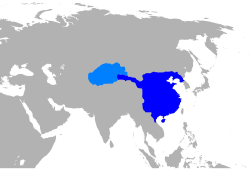
Four centuries before the Tang, the Han dynasty built the imperial template that every later Chinese state claimed to inherit: a centralized bureaucracy chosen in significant part by merit, a professional army projecting power deep into Central Asia, a unified written culture, and a capital whose name became the Chinese people's own. For Tang statesmen and historians, the Han was the supreme reference point — the standard by which the Tang's own achievements, and failures, were judged.
Founding and Consolidation
The Han was founded by Liu Bang, a commoner soldier of peasant origin who defeated the aristocratic Xiang Yu in the civil wars after the fall of the short-lived Qin (221–207 BCE) and took the throne in 202 BCE as Emperor Gaozu. His dynasty, at first a fragile compromise between kingdoms and commanderies, was consolidated by his widow Empress Lü, then transformed by Emperor Wen, his son Emperor Jing, and above all his great-grandson Emperor Wu (r. 141–87 BCE), in whose long reign the empire pushed the Xiongnu confederation deep into the steppe, planted garrisons and commanderies across the Western Regions (present-day Xinjiang), and established the Protectorate of the Western Regions in 60 BCE. The historian Sima Qian — the father of Chinese historiography, whose Records of the Grand Historian (Shiji) was written under Emperor Wu — defined the shape of all later dynastic history, including the Tang’s own Old and New Books.
Institutions the Tang Inherited
The Tang’s debt to the Han was explicit and structural. The Tang three-department, six-ministry (shangshu sheng and the Six Boards) central government descends directly from the Han secretariat and the ministries first regularized under Emperor Wu. The idea of selecting officials through written examination originated in the Han recommendation system (chaju), from which the Sui and Tang keju examination developed. Han fiscal practice — registration of households and land, taxation in grain and cloth, state monopolies on salt and iron, price-stabilizing granaries — was codified in the Han government monographs of the Book of Han and served Tang reformers such as Du You, author of the Tang administrative encyclopedia Tongdian, as a treasury of precedents. Even the Tang equal-field system had a Han antecedent in the well-field theories and land-limitation edicts debated by Han officials.
Culture, Identity, and the Capital Connection
Han power fixed the geography of Chinese civilization. Emperor Wu’s expeditions opened what a German geographer would later name the Silk Road; Chang’an, the Han capital, was the first Chinese city of world scale, and the Tang made it their own capital with full awareness of the precedent — the Tang founder deliberately styled his dynasty’s capital the same Chang’an, and Tang ritualists modeled court ceremonies on Han practice. The Chinese majority population’s enduring self-designation as “Han people” and its written language as “Han characters” (hanzi) date to this primacy. Tang poets reached constantly for Han allusion: Li Bai and Du Fu both framed frontier and palace poems against Han precedents, and the figure of the Han frontier general — from Wei Qing and Huo Qubing to Li Guang — was the standing archetype for Tang military verse.
Parallel and Mirror
Tang historians read the Han as both model and warning. The usurpation of Wang Mang, who ended the Western Han in 9 CE after a long regency built on court favor, prefigured Wu Zhao’s path from consort to founding emperor of her own Zhou dynasty (690–705) — a parallel Tang contemporaries could not miss. The rise of consort clans and eunuchs that accompanied the Han’s decline likewise anticipated the Tang’s own late-dynasty pathologies. Sima Guang’s Zizhi Tongjian, the monumental history completed in the Northern Song, organizes both dynasties into a single narrative of founding brilliance, mid-dynasty overreach, and terminal court rot.
Historical Assessment
For the Tang, the Han was the proof that a Chinese empire could be built to last, the sourcebook for its institutions, and the yardstick of legitimacy. The Tang never ceased to define itself in Han terms — and thereby defined “China” for the millennium that followed. Where the Sui supplied the Tang its machinery, the Han supplied its memory.
References & Historical Sources
- Records of the Grand Historian (Shiji 史記) by Sima Qian; Book of Han (Han shu 漢書) by Ban Gu.
- Zizhi Tongjian, volumes covering both dynasties, for the Tang-era reading of Han history.
- Denis Twitchett and Michael Loewe (eds.), Cambridge History of China, vol. 1 (1986).
- Ying-shih Yü, Trade and Expansion in Han China (1967).