The An Lushan Rebellion (755–763)
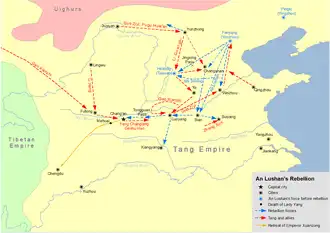
The rebellion that the Tang subject An Lushan launched on December 16, 755 was the defining catastrophe of the dynasty and, many historians argue, of medieval China as a whole. It nearly destroyed the Tang, reduced the census population by catastrophic proportions, ended the era of confident expansion, and permanently shifted the center of Chinese civilization south of the Yangzi. The dynasty survived for another century and a half — but as a different state.
Origins
An Lushan was a general of Sogdian-Turkic origin from the northeastern frontier who rose through military merit and court favor under Emperor Xuanzong. By the early 750s he commanded the three great northeastern commands of Pinglu, Fanyang, and Hedong — an unprecedented concentration of force — while remaining a favorite at court, where his corpulent clowning endeared him to the aging emperor and his consort Yang Guifei. Historians debate his motive: the standard sources, compiled after his death, portray a long-planned usurpation; revisionist scholarship notes that the court’s own provocations — chiefly the determined hostility of the chief minister Yang Guozhong, cousin of the consort, who repeatedly predicted An’s treason and thereby made it inevitable — may have forced his hand.
The Fall of the Two Capitals
An Lushan struck from Fanyang (Beijing region) in the eleventh month of 755 with perhaps 150,000 troops, claiming to march against Yang Guozhong. The imperial frontier armies had been drawn off for frontier campaigns, and the swollen but untrained palace guard in the capital collapsed; Tong Pass, the great chokepoint guarding Chang’an under the veteran general Gao Xianzhi, was lost after the court executed Gao and his colleague Feng Changqing on suspicion of treason — a blunder historians rank among the most costly in the dynasty’s history. In 756 Xuanzong abandoned Chang’an and fled toward Sichuan; en route, at Mawei station, his mutinous escort killed Yang Guozhong and forced the emperor to order the strangling of Yang Guifei. An Lushan took both capitals and proclaimed the Yan dynasty.
The Long War of Recovery
The Tang restoration was organized by Xuanzong’s son, who reigned as Suzong from Lingzhou, and was won by the Tang forces under Guo Ziyi, whose coalition armies — reinforced critically by Uyghur cavalry in exchange for sack rights over the recovered capitals — retook Chang’an and Luoyang in 757. An Lushan had by then been murdered by his own son An Qingxu, who was displaced in turn by the general Shi Siming, and Shi by his son Shi Chaoyi. The loyalist campaigns under Guo Ziyi and Li Guangbi slowly strangled Yan’s remaining strongholds; Shi Chaoyi killed himself in flight in 763, ending the war — even as, in the same year, a separate Tibetan invasion briefly occupied Chang’an while the field armies were elsewhere.
Demographic and Economic Catastrophe
The rebellion’s cost was staggering. The official census of 755 recorded roughly 52.9 million people in 8.9 million households; that of 764 recorded about 16.9 million in 2.9 million households — figures that reflect both real mortality and mass flight beyond registration, but that contemporaries experienced as the near-evacuation of the north China plain. The canal system was wrecked; the capitals’ food supply depended thereafter on emergency grain shipments organized by the salt administrator Liu Yan; and the fiscal settlement of the post-war decades (the two-tax reform of 780) effectively abandoned the old equal-field and tax-grain-cloth system in favor of taxation assessed on property and acreage. Economically, the baton passed to the Yangzi delta: the southeast became the empire’s fiscal heartland, a reorientation that persisted through the Song and beyond.
The End of an Era
Militarily, the peace settlement institutionalized the disease the war was supposed to cure: the surrendered Yan generals were confirmed as jiedushi of their own circuits, and within a generation the northeastern commands were passing their posts hereditarily. The power of the court never recovered; eunuch control of the palace army, warlord autonomy, and fiscal dependence on the southeast are all legacies of 755. Culturally, the rebellion marks the great divide of Tang poetry — from the expansive, confident verse of Li Bai and the young Du Fu to the harrowed late Du Fu, whose “Journey North” and ballads of the war are the most direct documentary record of the catastrophe a literary tradition has ever produced.
Historical Assessment
The rebellion closed the High Tang as decisively as it began the Late Tang. Modern historians such as Denis Twitchett treat it as the hinge between medieval and late imperial China: the centralized, aristocratic, expansionist early empire gave way to a more regionalized, more commercial, more bureaucratic order. The Tang lived on for a century and a half, but in the well-worn image, the light had gone out in the northwest; the future lay in the southeast.
References & Historical Sources
- Old Book of Tang, annals of Xuanzong, Suzong, and Daizong; biographies of An Lushan, Guo Ziyi, and Li Guangbi.
- New Book of Tang, treatise on the military governors (bingshi).
- Zizhi Tongjian, volumes 217–222.
- Du Fu, “A Journey North” (Beizheng) and “Three Officials” and “Three Partings” poems, as contemporary testimony.
- Denis Twitchett (ed.), Cambridge History of China, vol. 3, chapters on the rebellion and its aftermath.