Yue Jue Shu
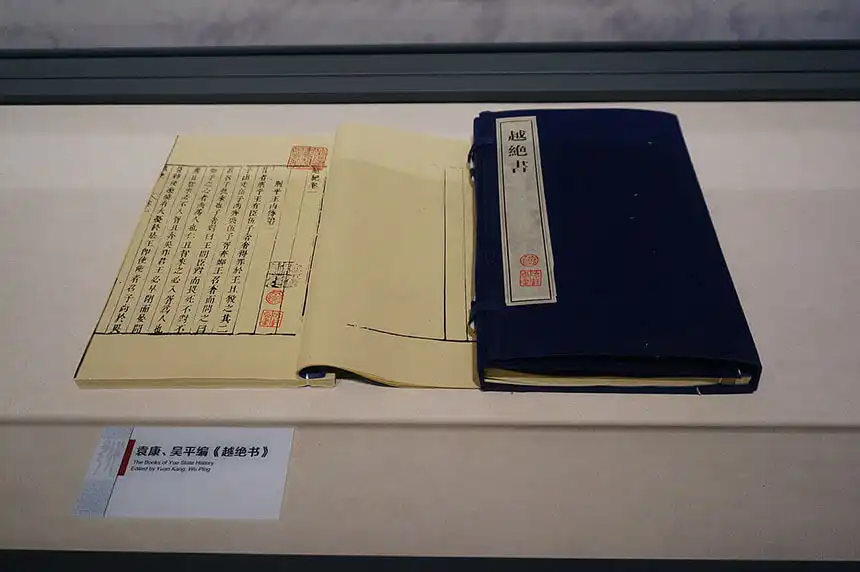
The Yuejueshu (越绝书, 'Lost Chronicles of Yue') is a history of the ancient southeastern state of Yue, compiled around the first century CE from older materials, traditionally attributed to Yuan Kang and revised by Wu Ping. Written as much as a historical romance as an annal, it is the principal surviving source for the kingdoms of Wu and Yue in the Spring and Autumn period — for the wars of Helü and Fuchai of Wu against Goujian of Yue, and for the advisors Fan Li and Wen Zhong who made Yue's final victory possible.
A History from the Edge of the Chinese World
The Yue kingdom of the sixth and fifth centuries BCE occupied the Yangzi delta and the coast south of it — at the very margin of the Zhou world, whose central states regarded its people as semi-barbarian. The Yuejueshu preserves that kingdom’s own memory of the age when it briefly stood at the center of Chinese politics: the generation-long duel between Wu (Suzhou) and Yue (Shaoxing), in which the Yue king Goujian (r. 496–465 BCE) suffered total defeat, endured captivity as his enemy’s servant, and returned to destroy Wu and dominate the Chinese world — only, in the work’s most famous thread, to turn on his own greatest ministers once the work was done.
The Book and Its Authorship
The received text runs to fifteen chapters — parts of an original architecture of “inner” and “outer” books that had already lost pieces by the tenth century. Its traditional ascription to Yuan Kang (fl. c. 40 CE) with revision by Wu Ping is early but not secure; modern scholarship treats the book as a layered compilation of Wu-Yue chronicle material, geographical description, and essays on statecraft, assembled under the Eastern Han. Its prose is unlike the sober annals of the central states: it mixes dialogue, prophecy, stratagem and anecdote in a narrative voice that later readers found as entertaining as instructive — the Chinese historical romance in embryo.
Fan Li, Wen Zhong and the Art of Statecraft
The work’s immortal figures are Goujian’s two advisors. Wen Zhong supplied the program — the multiplication of population, the stockpiling of grain, the patient husbanding of strength across twenty years of deliberate national austerity. Fan Li, the strategist and economist, engineered the war and the diplomacy; and, in the most cited episode of the whole book, he read his master’s character with terrible clarity. Once Wu had fallen, Fan Li fled the court, leaving Wen Zhong a letter whose warning became a proverb of Chinese political wisdom: the ruler can share hardship with his ministers but not triumph; “when the flying birds are gone, the good bow is put away; when the cunning rabbits are dead, the hunting dog is cooked” (飞鸟尽,良弓藏;狡兔死,走狗烹). Wen Zhong stayed — and was forced to suicide. Fan Li, legend adds, sailed east to the sea and became the merchant prince Tao Zhu, the richest man of his age: the rare Chinese sage who got both wisdom and a happy ending.
Value and Afterlife
For the historian, the Yuejueshu is indispensable precisely where the great central chronicles are silent — on the southeast, on naval and riverine warfare, on the techniques of statecraft by which a marginal kingdom conquered the center. Its accounts of Goujian’s hardship years seeded a thousand later works, from the Warring States strategists to the Ming historical novels. And its Fan Li aphorisms passed into the bloodstream of Chinese political language: any official who has ever calculated the danger of success is quoting this book without knowing it.