Yangtze River
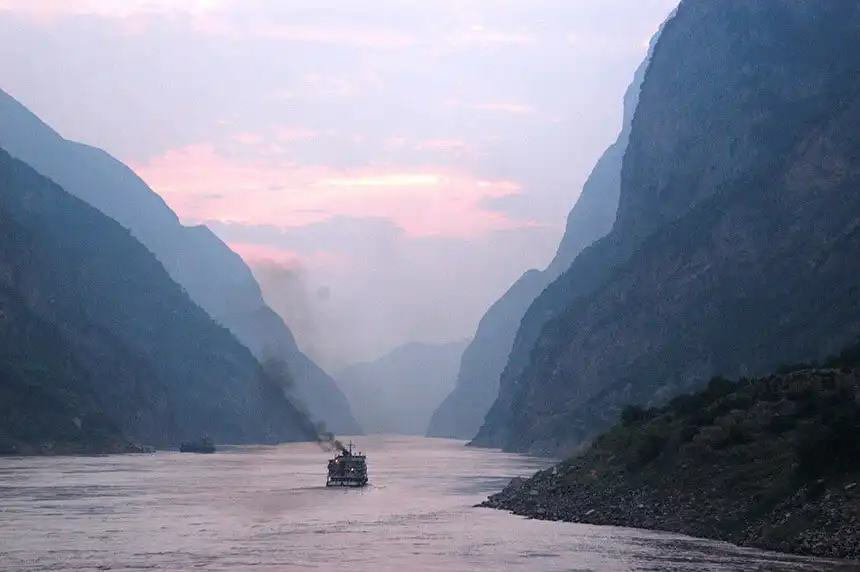
The Yangtze — Chang Jiang, the Long River — is China's greatest waterway: 6,300 kilometers from the Tibetan plateau to the East China Sea, draining one-fifth of the country's land. Under the Tang it was the empire's economic lifeline; the saying of the age ranked the cities of the realm 'Yangzhou first, Yizhou (Chengdu) second,' and Yangzhou stood on the Yangtze delta. Its gorges, its ports and its crossing points structured the dynasty's poetry, its logistics and its wars.
The River and the Empire
No river shaped the Tang more decisively. The Yellow River basin held the capitals and the political heartland; the Yangzi held the wealth. From the mid-eighth century onward — decisively after the An Lushan rebellion shattered the north — the lower and middle Yangzi became the dynasty’s fiscal engine, sending rice, silk, salt and coin north by canal and by coastal junk to keep the government alive. The transformation was so complete that historians speak of the Tang as the first Chinese dynasty that was, economically, a southern empire ruled from the north.
The river’s ports were the world’s busiest markets. Yangzhou, on the Grand Canal’s junction with the Yangzi, was the richest city of the age — a cosmopolitan entrepôt of several hundred thousand souls, where Persian and Arab merchants traded, where the salt monopoly was administered, and where, in the poets’ formula, one found the most dazzling singing-girls and the highest prices in the empire. Jinling (Nanjing) on the lower river, the old southern capital, lent its melancholy ruins to a thousand poems of dynastic rise and fall. Upstream lay Jiangling (Jingzhou), guardian of the middle reaches; and at the river’s western end, the gorges.
The Three Gorges
The Qutang, Wu and Xiling Gorges — two hundred kilometers of sheer limestone corridors where the river drops through the mountains of the Sichuan-Hubei border — were the most dramatic journey in the Chinese world. The Tang traveler Li Bai’s quatrain is the gorges’ eternal advertisement: “Bidding farewell at dawn from Baidi Town among the colored clouds, a thousand li to Jiangling in a single day; the gibbons on the banks cry without cease, while my light boat has already passed ten thousand mountains.” The gorges were also a strategic fact: the river narrows there, and control of the Three Gorges meant control of the route between the Sichuan basin and the eastern plains — a fact every dynasty of division relearned.
The River in Tang Poetry
The Yangzi is the single most pervasive landscape in Tang verse. It is Li Bai’s mirror and highway — he wrote his best poems on its boats, and, by legend, drowned reaching for the moon at its waters. It is Du Fu’s western horizon from his Kuizhou exile, where he wrote the meditations of his last years watching the “endless river” roll east. It is the great divider of homesickness in every exile’s lament: to cross the Yangzi was, depending on one’s direction, to leave home or to enter politics — the river marked both journeys. The river carried the examination candidates, the exiled officials, the tea and the salt — and the poets simply wrote down what the current was already saying.
Ecology and Modernity
The modern Yangzte bears the weight of the present as the Tang river bore the wealth of its age: the Three Gorges Dam, the largest hydroelectric station on earth, has transformed the gorges, the fisheries and the flood regime of the entire basin, while industrialization has burdened the river with every form of pollution. The baiji, the Yangtze river dolphin — known to Tang fishermen and mourned in modern verse — was declared functionally extinct in the early twenty-first century. The river that fed the Tang now feeds a fifth of China’s population and generates a fifth of its economy: the Long River’s burden has never been heavier, nor its history longer.