Sancai
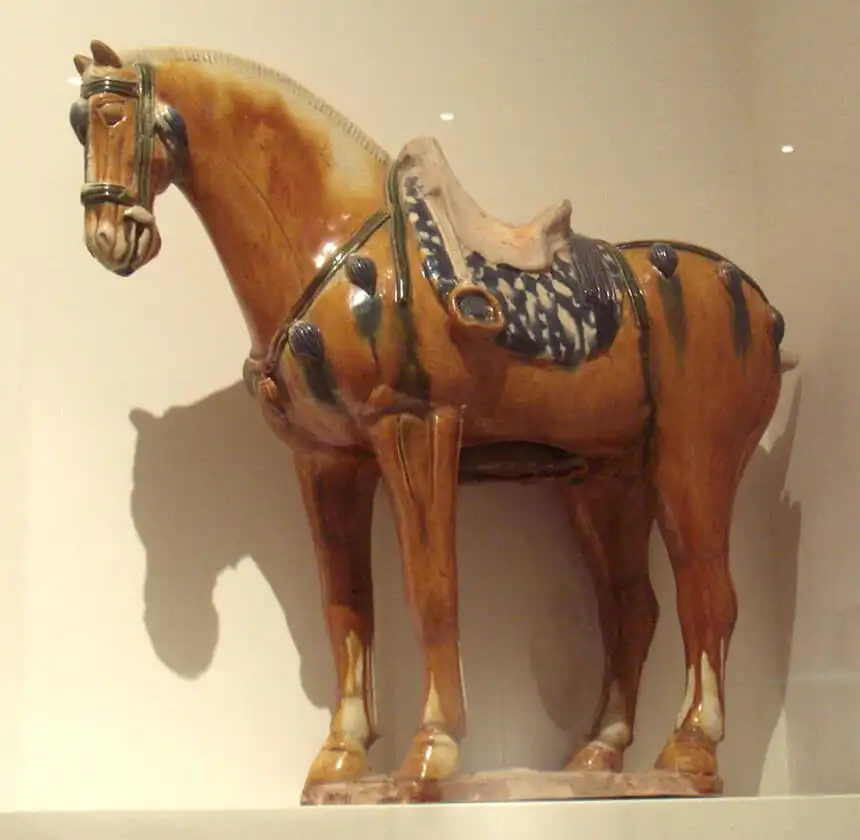
Sancai — 'three colors' — is the polychrome lead-glazed earthenware of the Tang dynasty, made above all for the tomb. Flowing amber, green and cream glazes over molded figures of horses, camels, guardians and court ladies have made it the most immediately recognizable ceramic of any Chinese period. Since its first great discoveries at Luoyang in the early twentieth century, it has been known in China as Tang sancai and in the West, for its streaked green-and-cream look, as 'egg-and-spinach' ware.
The Technique
Sancai is a low-fired earthenware with a lead glaze colored by metal oxides: iron for amber and brown, copper for green, cobalt — imported, expensive, and therefore rare — for the celebrated blue that marks the finest pieces. The body was molded in sections, assembled, and fired; the glazes were then applied and the piece fired a second time at a lower temperature. In the kiln the lead glazes ran and mingled, so that no two sancai surfaces are identical — the streaked, marbled effect that made dealers call it egg-and-spinach. The process was far cheaper than true porcelain, which required kaolin and very high firing: sancai could be made big, made fast, and made splendid.
Made for the Dead
The single most important fact about sancai is where it was found: tombs. The great glazed horses and camels, the guardian warriors, the civil officials, the plump court ladies, the offering trays and granary jars were mingqi (冥器) — grave goods, manufactured in enormous workshops near the two capitals to furnish the afterlife of the Tang elite. Almost no sancai was made for the living, and almost none should ever have been excavated: the vast majority of surviving pieces comes from Tang tombs opened in the twentieth century, above all around Luoyang — where the kilns and the burials concentrated together — which is why the ware is still called “Luoyang Tang sancai” in the Chinese trade. To own a sancai horse today is to own a piece of someone’s carefully provisioned eternity.
The Gallery of the Tang World
The tomb figures are the dynasty’s own group portrait. The horses — modeled on the great Central Asian bloodstock that was the Tang’s emblem of power, one hoof raised, manes knotted, saddled in blue — are the most famous images in all of Chinese ceramics. Beside them walk the camels of the Silk Road caravans, laden with goods, attended by Sogdian and Turkic grooms with deep-set eyes and foreign dress: the cosmopolitan empire casting itself in clay. The court ladies in high coiffures and long skirts preserve the fashion plates of the eighth century; the ferocious guardian beasts (镇墓兽) with their horned, winged, leopard-bodied hybrids guarded the tomb passages; the civil officials, the musicians, the polo players round out a society in miniature. The chronology is readable: the finest work belongs to the high Tang, especially the Xuanzong decades; after the An Lushan catastrophe the figures grow smaller, meaner, fewer.
Spread and Influence
Sancai traveled. Pieces and local imitations appear across the trade world of the eighth and ninth centuries — Japan (where the Shosoin preserves related glazed wares), the Korean peninsula, West Asian sites along the caravan roads — plain evidence that Tang luxury goods moved with the caravans. The technique also seeded descendant traditions: the polychrome lead-glazed wares of the Liao dynasty, and the sancai revival wares of the Ming and Qing, made for a market that had never stopped loving the look. Modern Luoyang still produces sancai for the souvenir trade, an industrial descendant of the Tang kilns.
In the Museum
Today Tang sancai fills the ceramic galleries of the world’s museums — the British Museum, the Guimet, the Met, the Luoyang Museum by the thousand — and fetches enormous prices at auction, where blue-glazed examples are the rarest treasures. Every label carries the same quiet caveat: each piece was made to be buried, and seen again only by breaking a tomb’s thousand-year sleep.