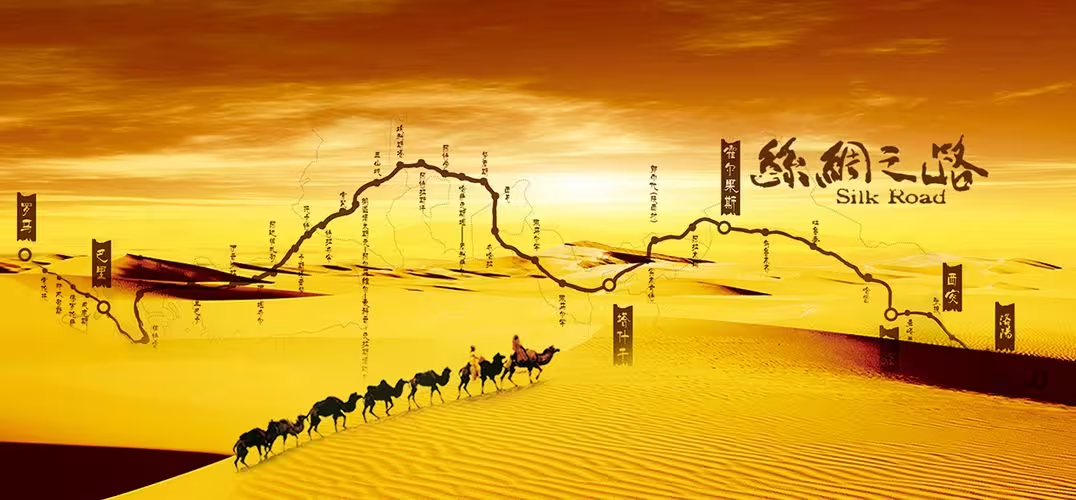
During the seventh and eighth centuries, the Silk Road was neither a single paved highway nor a purely commercial track—it was the geopolitical nervous system of Eurasia, with Chang’an beating at its eastern heart. Under the Tang dynasty, military hegemony in the Tarim Basin merged with an unprecedented openness to foreign peoples, turning overland caravan tracks and monsoon sea lanes into conduits of silver, silk, scripture, and statecraft.
At the western edge of the capital stood the Western Market (Xishi, 西市), a walled commercial grid where Sogdian caravan masters from Samarkand and Bukhara traded lapis lazuli, thoroughbred Fergana horses, and glassware for bolts of raw and damasked Tang silk. Persian nobles fleeing the fall of the Sasanian Empire took refuge in the Tang court, while Nestorian Christian monks, Zoroastrian priests, and Manichaean scholars erected temples alongside Buddhist monasteries.
Sustaining this exchange required relentless frontier administration. Through the Protectorate General to Pacify the West (Anxi Duhufu, 安西都护府), Tang garrisons guarded the northern and southern rims of the Taklamakan Desert, ensuring safe passage across the Pamir Mountains. Even after the mid-eighth-century An Lushan Rebellion loosened Tang control over the Western Regions, trade shifted southward toward Guangzhou and Yangzhou, where tens of thousands of Arab, Persian, and Southeast Asian merchants anchored the rising Maritime Silk Road.