Personal Name:
Wu Zetian (Wu Zhao) 武则天 / 武曌
Reign: 690 - 705 (Tianshou – Shenlong)
Zetian Dasheng (Wu Zhou) 则天大圣皇帝
Temple name
Emperor Zetian Shunsheng 则天顺圣皇后皇帝
Posthumous name
The Legacy
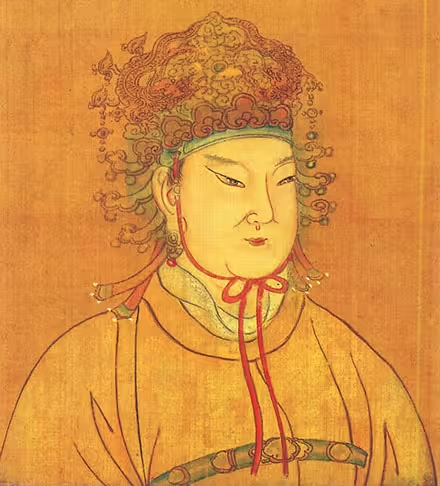
Wu Zetian (17 February 624 – 16 December 705), personal name Wu Zhao (武曌), was the de facto ruler of the Tang empire for nearly half a century and the sole female sovereign in Chinese history to reign in her own name as Huangdi (Emperor), ruling her Wu Zhou (武周) dynasty from 690 to 705. Rising from a low-ranking concubine in Taizong’s palace to empress consort under Gaozong, regent empress dowager, and finally emperor, she shattered the deepest patriarchal taboo of imperial China.
Confucian historians of later centuries condemned her usurpation and personal ruthlessness, yet even her fiercest critics—such as Sima Guang in the Zizhi Tongjian—conceded that she possessed an uncanny eye for administrative talent and left the empire prosperous and intact. By breaking the political stranglehold of the northwestern aristocratic clans and elevating men of modest background through the civil service examinations, Wu Zetian reshaped the social architecture of medieval China and laid the institutional foundations for the High Tang golden age under her grandson, Emperor Xuanzong.
Reign & Achievements
Meritocracy and the examination revolution. To counter the entrenched Guanlong aristocracy (关陇集团) that had dominated the early Tang court, Wu Zetian dramatically expanded the imperial examination system (keju). She introduced palace examinations (dianshi, 殿试) presided over by the sovereign in person, instituted anonymous grading (huming, 糊名) to curb nepotism, and established military examinations (wuju, 武举). Her willingness to promote capable administrators regardless of pedigree—most notably Di Renjie, Yao Chong, and Song Jing—created a new governing elite loyal to the throne rather than to hereditary lineage.
Agrarian stability and fiscal prudence. Throughout her regency and Wu Zhou reign, the empire experienced sustained population growth and relative domestic peace. She ordered the compilation of agricultural manuals (Zhaoren Benye, 兆人本业), rewarded local magistrates whose prefectures saw rising census numbers and reclaimed farmland, and kept taxation light enough to sustain frontier logistics without sparking peasant revolts.
Frontier defense and Silk Road recovery. Despite initial setbacks against the Tibetan Empire and Khitan raiders in the 690s, Wu Zetian swiftly restored Tang hegemony in Central Asia. In 692, her general Wang Xiaojie recaptured the Four Garrisons of Anxi (Kucha, Khotan, Kashgar, and Karashahr), securing the Tarim Basin and reopening the overland Silk Road for the next half-century. She also stabilized the northern steppe frontier through a combination of military containment and marriage diplomacy with the Eastern Turkic Khaganate.
Controversies & Failures
Purge of the Tang imperial clan. Wu Zetian’s path to supreme power was paved with blood. Between the elimination of Empress Wang and Consort Xiao in 655 and the suppression of the Tang princes’ rebellion in 688, she systematically dismantled the Li royal house and its aristocratic allies, including elder statesmen Zhangsun Wuji and Chu Suiliang. Even her own sons were not spared: Crown Prince Li Hong died suddenly under lingering suspicion, Li Xian was forced into exile and suicide, and both Zhongzong and Ruizong were deposed at her pleasure.
The reign of terror and secret police. Following the 684 uprising of Li Jingye, Wu Zetian authorized a network of informants and ruthless inquisitors—led by Lai Junchen and Zhou Xing—who used torture and fabricated treason charges to decimate the court bureaucracy. Once the old aristocracy was broken in the late 690s, she astutely executed Lai Junchen and dismantled the apparatus, yet the years of paranoia left a lasting stain on her reputation.
Late-reign favoritism and the Shenlong Coup. In her final years, as age and illness isolated her from daily court business, Wu Zetian fell under the influence of the Zhang brothers (Zhang Yizhi and Zhang Changzong), whose corruption alienated both civil officials and imperial guards. In February 705, the eighty-one-year-old emperor was forced to abdicate in the Shenlong Coup led by Chancellor Zhang Jianzhi, restoring the Tang dynasty under Emperor Zhongzong months before her death.
The Defining Trait: The Self-Made Sovereign
Wu Zetian’s defining genius lay in ideological invention. Lacking the patrilineal mandate required by Confucian orthodoxy, she constructed an entirely new framework of female imperial legitimacy—blending Buddhist messianism (circulating the Great Cloud Sutra proclaiming her a reincarnated Maitreya and Chakravartin ruler), Daoist omens, and archaic Zhou dynasty ritual. She elevated Luoyang into her “Divine Capital” (Shendu), promulgated newly coined Chinese characters—choosing 曌 (Zhao, sun and moon shining above the sky) for her own personal name—and proved that institutional statecraft, rather than bloodline, was the true locus of imperial authority.
Anecdotes & Folklore
- Taming “Lion’s Courser” (Shizicong). According to the Zizhi Tongjian, when Emperor Taizong possessed a fierce, untamable stallion, young Wu Zhao remarked that she needed only three items to subdue it: an iron whip, an iron hammer, and a dagger—to beat it, strike its head, and cut its throat if it still refused to obey. Taizong admired her audacity, though the episode later served historians as an early omen of her steel will.
- The Copper Urn (Gui, 匦). To bypass bureaucratic gatekeepers and encourage both policy proposals and treason reports, Wu Zetian installed four color-coded bronze boxes outside the palace gates, allowing any subject in the empire to submit sealed memorials directly to the throne.
- The Wordless Stele (Wuzibei). Buried beside Emperor Gaozong at the Qianling Mausoleum, Wu Zetian left behind a massive monolithic stele devoid of any inscription. Popular tradition holds she believed her achievements and faults were too vast for words—or best left to the judgment of future generations.
- The Midwinter Peonies. Legend recounts that during a freezing winter at Shanglin Garden, a drunken Wu Zetian decreed that all flowers bloom the next morning for her stroll. Every blossom obeyed overnight except the peony, which she supposedly banished to Luoyang—giving rise to Luoyang’s famed peony culture.
References & Historical Sources
- Jiu Tang Shu (旧唐书), juan 6 (Annals of Empress Zetian).
- Xin Tang Shu (新唐书), juan 4 (Annals of Empress Zetian) & juan 76 (Biographies of Empresses).
- Zizhi Tongjian (资治通鉴), juan 200–208 (Xianqing 1 through Shenlong 1).
- Richard W. L. Guisso, “The Reigns of the Empress Wu, Chung-tsung and Jui-tsung (684–712),” in The Cambridge History of China, vol. 3.
- N. Harry Rothschild, Emperor Wu Zhao and Her Pantheon of Devis, Divinities, and Dynastic Mothers (Columbia University Press, 2015).
- Jonathan Clements, Wu: The Chinese Empress Who Schemed, Seduced and Murdered Her Way to Become a Living God (2007).