Personal Name:
Li Heng 李亨
Reign: 756 - 762 (Zhide, Qianyuan, Shangyuan, Baoying)
Suzong 肃宗
Temple name
Emperor Wenming 文明皇帝
Posthumous name
The Legacy
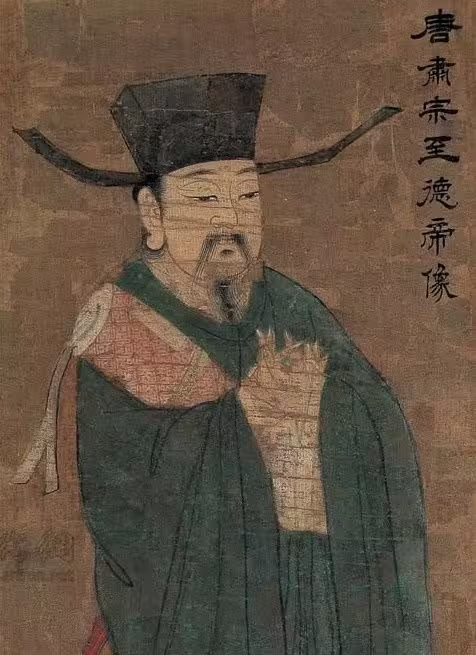
Emperor Suzong of Tang (19 October 711 – 16 May 762), personal name Li Heng, born Li Sisheng and renamed no fewer than five times in the factional crossfire of his father’s court, was the seventh emperor of the Tang dynasty. His reign was an emergency reign in the most literal sense: he was proclaimed emperor by mutinous necessity in a frontier garrison on 12 July 756, while his father was still alive and still sovereign in the empire’s eyes, because the An Lushan rebellion had left the dynasty an hour from its end.
Suzong’s historical position is double. On one side stands the restoration itself: without the Lingzhou enthronement there might have been no Tang to restore at all. On the other stands what the emergency cost — the permanent devolution of military power to regional commanders, the elevation of eunuchs to command of armies and gatekeeping of the emperor, and a fiscal ruin from which the dynasty never fully recovered. The historians’ judgment is restrained admiration with a hard edge: he saved the dynasty and mortgaged its future to save it.
Reign & Achievements
The march north and the enthronement at Lingwu. When the imperial flight reached Mawei Station in July 756, the local elders blocked the road and begged the crown prince to stay and lead the resistance rather than follow his father into Shu. Li Heng took the hint, turned north through Guyuan, and at Lingzhou on 12 July 756 was acclaimed emperor by the frontier garrison — without Xuanzong’s knowledge or approval. The old emperor, on learning of it from Chengdu, ratified the fait accompli with grace and took the title of retired emperor. The psychology of the gesture mattered enormously: the empire now had a fighting court, not a fleeing one.
The recapture of the capitals. With the great general Guo Ziyi and, crucially, cavalry borrowed from the Uyghur Khaganate — purchased at the price of permission to plunder the recovered capitals — the new government counterattacked. In September 757 the imperial army annihilated An Qingxu’s main host at the Temple of Fragrant Accumulation (香积寺) outside Chang’an; the city fell, then Luoyang. The rebel leadership consumed itself: An Qingxu was killed by his fellow-rebel Shi Siming in 759, and Shi Siming in turn was murdered by his own son Shi Chaoyi in 761 — the rebellion’s best generals were doing the dynasty’s work. Luoyang was retaken in 762 with a second Uyghur alliance, and Shi Chaoyi fled to his death in the first days of 763.
Holding the line. Between the battles, Suzong’s government performed the unglamorous miracles of emergency rule: relocating the defeated bureaucracy, re-establishing tax collection in Guanzhong and the Huai valley, keeping the Yangzi logistics flowing through the loyal southeast, and fending off the brief but dangerous revolt of his half-brother Li Lin, the Prince of Yong, who tried to carve out an empire in the lower Yangzi in 757 and was crushed within months.
controversies & Failures
The slander that killed a prince (757). Suzong’s ablest son, the Prince of Jianning Li Tan, denounced the eunuch Li Fuguo and the emperor’s favorite consort Zhang Liangdi for corruption. They struck first: Li Tan was executed on their accusation of treason. The emperor believed the accusation; only after his own death was the prince’s name cleared by Daizong. It was the dynasty’s first great case of a sovereign destroying his own best blood on a eunuch’s word — and far from the last.
The catastrophe at Yecheng (759). The dynasty’s nine military governors converged on the rebel-held city of Yecheng with an army of perhaps 600,000, led less by strategy than by rivalries and by the supervising eunuch Yu Chao’en. When the front collapsed in a single day, the imperial side blamed its own best general, Guo Ziyi, and withdrew him. From that debacle dates the hardening of the lesson: armies belonged to their jiedushi, not to the throne.
The eunuch ascendancy. Li Fuguo, who controlled access to the emperor and styled himself “royal father” (尚父), publicly told the retired Xuanzong at Xingqing Palace: “Your Majesty need only sit inside the palace; leave outside affairs to your old servant.” Yu Chao’en accumulated extraordinary titles and a Buddhist temple on Mount Hua built with tax money. Pugu Huai’en, the general who had brokered the Uyghur alliance and won the war’s hardest fights, was hounded by court slander into open rebellion in 763 and died a traitor — the pattern by which the dynasty kept manufacturing its own rebels.
The Defining Trait: The Emergency Sovereign
Suzong’s defining trait was the courage of the second choice. At every decisive moment — turning north at Mawei, taking a throne not offered, borrowing barbarian cavalry to save a Chinese capital, trading pardon for rebel defections — he chose the option that kept the dynasty alive over the option that kept it pure. He was not a great emperor; he was something rarer in that age, a merely necessary one, and he knew it.
Anecdotes & Folklore
- “Father and son each follow his road.” At the Mawei crossroads, when the crowd begged the prince to stay, Xuanzong is said to have watched his son depart and told the attendants: “Heaven and the people both want it; I cannot oppose them” — and sent the rear guard with him. The scene, choreographed or not, gave the new reign its founding legend.
- The poet caught in a prince’s revolt. When Li Lin rose in the Yangzi, the poet Li Bai, then in his fifties and desperate to matter, joined his staff as an adviser. The revolt collapsed in weeks; Li Bai was imprisoned at Jiujiang under sentence of death, saved by the intervention of the general Guo Ziyi — whom the poet had once defended from a flogging years before — and exiled to Yelang. He was pardoned en route and wrote the poems of his late greatness.
- The eunuch’s masterstroke. In May 762, as Suzong lay incapacitated, Empress Zhang moved to kill Li Fuguo and enthrone her own candidate. Li Fuguo struck first, strangling the empress with the connivance of her own guards — three days before the emperor died. Power passed to Daizong without a shot, and the eunuch who had arranged it was, within months, quietly eliminated by the new emperor he had made.
- Buying back Chang’an with a sack of gold. The terms of the Uyghur alliance were blunt: the khagan’s cavalry would fight for the right to loot Luoyang. When the city fell in 762, the court had to bargain the population’s property against a scheduled sack — the Zizhi Tongjian preserves the grim arithmetic of victory.
References & Historical Sources
- Jiu Tang Shu (旧唐书), juan 9–10 (Annals of Suzong).
- Xin Tang Shu (新唐书), juan 6.
- Zizhi Tongjian (资治通鉴), juan 218–222 (Tianbao 15 through Baoying 1).
- Tang Huiyao (唐会要), juan on the Shence Army’s early development.
- Denis Twitchett, “The Emperor and the Provinces: the crisis of 755–763,” appendix? — see Cambridge History of China, vol. 3, and his essays on the post-rebellion settlement.
- Pulleyblank, The Background of the Rebellion of An Lu-shan — on the rebellion’s military dynamics.
- Michael T. Dalby, “Court Politics in Late T’ang Times,” in Cambridge History of China, vol. 3 — on Li Fuguo and the eunuch precedent.