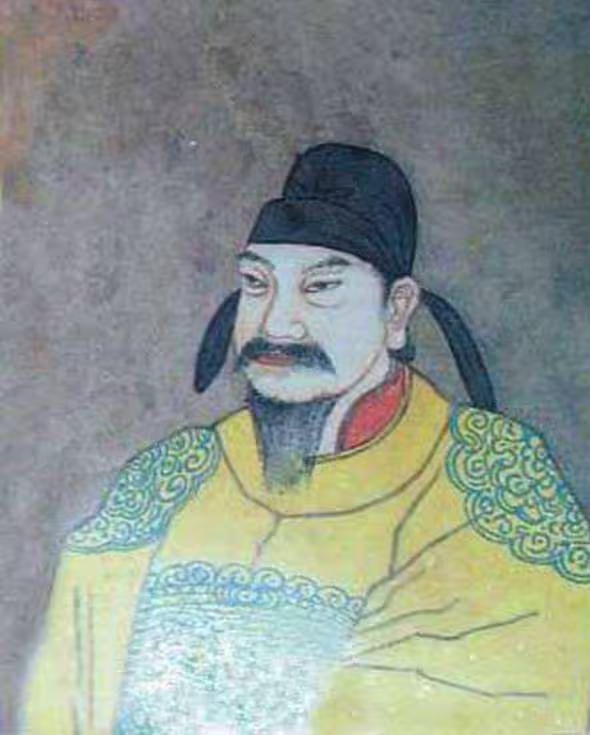
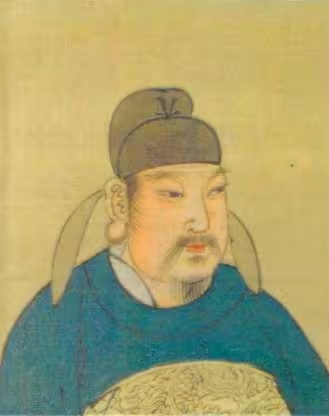
Personal Name:
Li Zhi 李治
Reign: 649 - 683 (Multiple (Yonghui to Hongdao))
Gaozong 高宗
Temple name
Emperor Tianhuang 天皇皇帝
Posthumous name
The Legacy
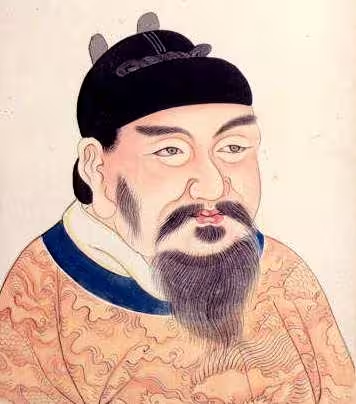
Emperor Gaozong of Tang (21 July 628 – 27 December 683), personal name Li Zhi, was the third emperor of the Tang dynasty, reigning for thirty-four years from 649 to 683 — the longest reign of early Tang and, at the time, a tenure unmatched since Han Wudi. He was the ninth son of Taizong and the third born to Empress Zhangsun, and he came to the throne as a surprise choice after the succession crisis of 643.
His reign divides neatly in two, and history has judged the halves asymmetrically. The first decade, the Yonghui era (永徽之治), was praised by Sima Guang as leaving the people prosperous and secure, “with the legacy wind of Zhenguan” — a judgment echoed in both Tang histories. The second half belongs, in the popular telling, to his empress Wu Zetian, who gradually assumed the substance of power as his health failed. Gaozong died leaving a will that made Wu the arbiter of all affairs of state — the hinge on which the Tang dynasty swung toward the fifteen-year Zhou interregnum. Yet the territorial record belongs to him: under Gaozong the Tang reached its maximum extent, annihilating both Baekje and, climactically, Goguryeo itself.
Reign & Achievements
The Yonghui administration (649–655). Gaozong inherited Taizong’s cabinet almost intact and kept it: Zhangsun Wuji, Chu Suiliang, Li Shiji and others continued the Zhenguon program. The era’s most durable monument is legal: the Yonghui Code and its official commentary, completed in 653, which matured into the Tang Code with Commentary (唐律疏议) — the most influential law code in East Asian history, adopted in essences by Japan, Korea and Vietnam. Economically, the registers showed sustained growth, and the examination system quietly expanded.
The destruction of the northeast kingdoms. Gaozong inherited the unfinished Korean problem. In 660 Su Dingfang, allied with Silla, destroyed Baekje in a textbook amphibious campaign. When Baekje and Yamato Japan attempted a restoration, Liu Rengui annihilated the Japanese fleet at the Battle of Baekgang (白江口, 663), the largest naval engagement in East Asian history to that date. In 668, after meticulous preparation and with the Khitan and Xi auxiliaries, Li Shiji stormed Pyongyang: Goguryeo, the nemesis of Sui Yangdi and Taizong alike, fell after some seven centuries of kingdom, and the Protectorate-General of Andong was established on its soil.
The western frontier. Su Dingfang smashed the Western Turkic Khaganate in 657 and captured its khagan Ashina Helu, while further armies pushed toward the Pamirs; protectorates were planted in the Tarim oases. The price of overextension showed at the Dafei River (大非川) in 670, where Xue Rengui’s army was crushed by the rising Tibetan Empire — the first great Tang reverse in the west, and the beginning of a sixty-year struggle for the plateau’s approaches.
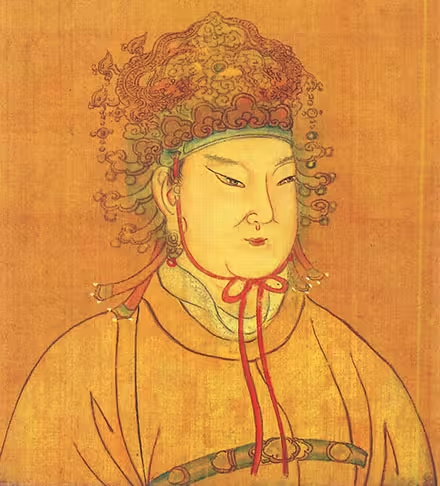
The co-rule of the “Two Saints.” From the mid-660s Gaozong suffered chronic debilitating illness — vertigo, headaches and episodes of near-blindness, plausibly severe hypertension or stroke. Court ritual adapted: Wu Zetian, by now empress and from 674 styled Tianhou (“Heavenly Empress”) opposite his Tianhuang (“Heavenly Emperor”), read the memorials and decided policy with him. Foreign embassies were received by the “Two Saints” (二圣) side by side. The machinery of state never broke down — which is precisely why the arrangement outlived him.
controversies & Failures
The deposition of Empress Wang (655). Gaozong’s determination to make Wu Zhao empress in place of Empress Wang shattered his early government: Chu Suiliang threw down his court tablet and retired bleeding from the forehead; Zhangsun Wuji was exiled and forced to suicide in 659. Historians have debated for thirteen centuries whether Gaozong was a lovesick weakling manipulated by a brilliant schemer, or a cold political operator using Wu to break the Zhangsun aristocratic bloc. The sources support both readings; the consequences are not in doubt — the old Zhenguan elite was gone, and power concentrated in the palace.
The fate of his sons. Two successive crown princes died in suspicious circumstances: Li Hong died suddenly at Hebi Palace in 675 (the old histories hint at poisoning by Wu; modern scholars remain divided), and Li Xian was deposed in 680 and forced to suicide in 684. Whether Gaozong knew, suspected or could not act is unknowable — the pattern is the darkest stain on a mild reign.
The Silla betrayal. Having destroyed Goguryeo and Baekje as allies of Silla, Gaozong watched Silla absorb the peninsula. The ensuing Silla–Tang war (670–676) ended with the Tang abandoning territory south of the Taedong; the Andong protectorate shrank steadily. Victory in 668 had created a commitment the empire could not sustain.
The Defining Trait: The Ailing Consolidator
Gaozong’s defining quality was stamina in the face of physical collapse. For more than two decades he presided — signing, judging, receiving — while a chronic illness progressively stole his strength and his sight, delegating ever more to Wu Zetian without ever quite relinquishing the throne. The result was a reign of genuine achievement wrapped in genuine pathos: the empire’s greatest expansion and the dynasty’s greatest long-term risk, executed by the same pen.
Anecdotes & Folklore
- The tears that won an empire. In 643, when Taizong wavered between his sons Li Tai and Li Zhi, the story goes that Li Zhi wept continuously beside his father during the crisis over Li Chengqian’s fall, and that his manifest grief and simplicity decided the succession in his favor. Courtiers, notably Chu Suiliang, argued that “a foolish son is easy to keep” — the state needed no second genius, only a vessel for good ministers.
- “Let all blame fall on me.” On the campaign against Goguryeo, when supply lines failed in the mountains, Gaozong issued the order recorded in the histories: reduce the army’s rations, and “if the troops must suffer, let the suffering be charged to Us alone” (士苦,皆以闻于朕). Whether oratory or record, it was the rhetoric of a ruler schooled in Taizong’s mirror.
- The confrontation at the screen (664). Learning that a servant girl of Wu Zetian practiced witchcraft against him, and secretly discussing deposition with Chancellor Shangguan Yi, Gaozong was betrayed to Wu. She confronted him weeping; cornered, he blurted out that it had all been Shangguan Yi’s idea. The chancellor was executed; Gaozong never again moved against her. The scene, preserved in the Zizhi Tongjian, is the defining portrait of the second half of the reign.
- The medicine that failed. As his illness deepened, the court exhausted its pharmacopoeia; the histories record failed prescriptions, summoned monks and hermits, and the emperor’s own wry endurance — “the illness is in Our head, yet the ministers’ hearts are the ones aching.” He died at Luoyang’s Zhenguan Hall on 27 December 683, aged fifty-five.
- The joint tomb. Gaozong alone among Tang emperors shares his mausoleum: Qianling (乾陵), outside Chang’an, built to house both him and Wu Zetian, fronted by the wordless stele she would later raise. Two sovereigns, one mountain — the arrangement is unique in Chinese history.
References & Historical Sources
- Jiu Tang Shu (旧唐书), juan 4–5 (Annals of Gaozong); juan 6 (Annals of Zhongzong and Ruizong for the aftermath).
- Xin Tang Shu (新唐书), juan 3.
- Zizhi Tongjian (资治通鉴), juan 199–208.
- Tang Huiyao (唐会要), juan on law codes and on the two capitals.
- Denis Twitchett & Howard Wechsler, “Kao-tsung and the Empress Wu,” in The Cambridge History of China, vol. 3 — the standard English treatment.
- R. W. L. Guisso, Wu Tse-t’ien and the Politics of Legitimation in T’ang China — on the Wu Zetian dimension.
- Graff, Medieval Chinese Warfare, 300–900 — on the Baekgang and Pyongyang campaigns.