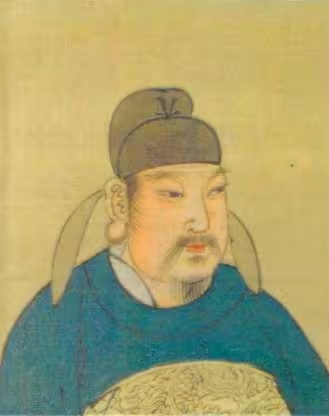
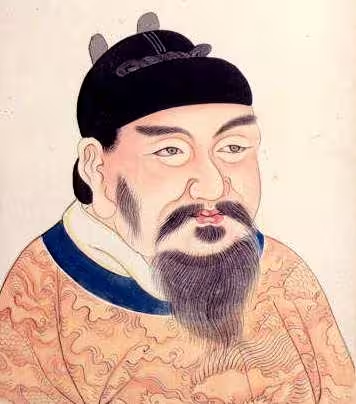
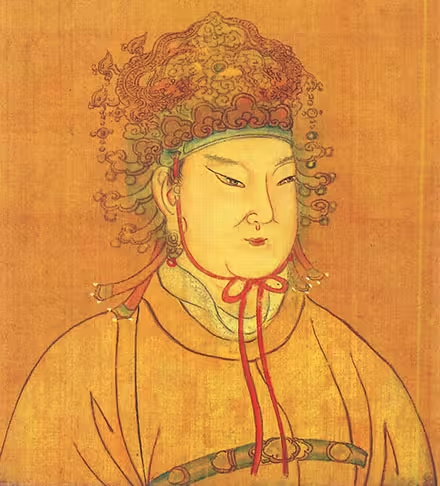
Personal Name:
Li Kuo 李适
Reign: 779 - 805 (Jianzhong, Xingyuan, Zhenyuan)
Dezong 德宗
Temple name
Emperor Shenwu 神武皇帝
Posthumous name
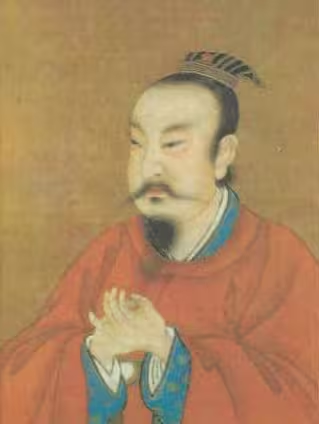
The Legacy
Emperor Dezong of Tang (19 May 742 – 25 February 805), personal name Li Kuo, was the ninth emperor of the Tang dynasty, reigning from 779 to 805 — a twenty-six-year tenure that began in reformist fire and ended in exhausted conciliation. He was the last Tang emperor to attempt the total reconstruction of the centralized state bequeathed by Xuanzong; the attempt nearly destroyed what it meant to save, and after 786 he settled for something less than victory and more than survival.
His biography carries the dynasty’s most quietly heartbreaking thread: his mother, Consort Shen, was lost during the sack of the capitals in 756 when he was fourteen, and he searched for her for the rest of his life — through rewards, through impostors, through decades of false hopes — and never found her. The historians pair the private grief with the public arc: the Jiu Tang Shu grants him the bearing and beginning of a restorer, and records the suspicion and weariness that undid the end.
Reign & Achievements
The Two-Tax reform (780). Working with his first chancellor Yang Yan, Dezong replaced the collapsed equal-field and zu-yong-diao system with the liangshui fa (两税法): taxes assessed twice yearly, in summer and autumn, payable in coin and calculated by household wealth and land — a fiscal revolution that matched taxation to reality and underpinned Chinese state finance for the next eight centuries. It remains, by any measure, the most consequential single reform of the dynasty.
The war on the jiedushi (781–786). When the great Hebei warlord Li Baochen died in 781, Dezong refused to let his son inherit Weibo’s neighbor Chengxde — the first flat refusal in a generation. The predictable explosion — rebellions by Li Weinüe, Tian Yue, Li Na and Liang Chongyi, ending in the declaration of four rebel “kingdoms” in Hebei — became a five-year war that drew in the empire’s greatest commanders. On the loyalist side stood the generation’s best: Li Sheng, who retook Chang’an from the usurper Zhu Ci in July 784; Hun Jian, defender of the besieged fortress of Fengtian; Ma Sui, who broke Li Huaiguang’s rebellion in the Yellow River bend. The self-styled Chu emperor Li Xilie was poisoned by his own general in 786. By that year every major rebel had died, surrendered or been executed — the only general peace Hebei would know before Xianzong’s campaigns.
The Xingyuan edict (784). Written by the scholar Lu Zhi while the emperor was a refugee at Fengtian, the “Edict of Self-Reproach” took upon the throne the blame for the whole calamity and promised amnesty to all rebels who submitted. When it was read to the armies, the Zizhi Tongjian records, soldiers wept. Historians rank it among the most effective pieces of political writing ever issued by a Chinese throne: within months the rebel coalitions were fracturing over it.
The Zhenyuan recovery. After 786, Dezong governed through quiet consolidation: rebuilding the treasury on the new tax system, restraining the court’s own spending in his genuinely frugal middle years, and keeping the warlords of Hebei in a state of armed, taxed, surly peace. Twenty years without major civil war was itself an achievement few of his neighbors on the throne ever managed.
controversies & Failures
The Jingyuan mutiny and the fall of Chang’an (783). The war’s supreme irony: unpaid, badly led soldiers of the imperial army itself mutinied as they passed through the capital in October 783, and within days Chang’an was lost — not to Hebei, but to its own garrison. The ex-warlord Zhu Ci, detained at court by the emperor’s own suspicion, was carried to the throne by the mutineers and besieged Dezong at Fengtian for forty days. The emperor never forgot who had opened the gates: his trust in generals, and for years in almost everyone, died at Fengtian. Contemporaries also blamed Chancellor Lu Qi, the subtly poisonous favorite whose spite helped send the loyal old hero Yan Zhenqing to his death at a rebel’s hands in 784.
The execution of Liu Yan (780). The empire’s financial architect, the man whose salt monopoly and canal system were feeding the state, was slandered to death by Yang Yan within months of the reform’s proclamation. No trial worthy of the name was held. Even by the standards of faction, it was a self-inflicted wound the court never quite admitted.
The conciliation of the eunuchs. After the mutiny, the emperor who had fled his own guards rebuilt his bodyguard under palace eunuchs — the Shence Armies, from 796 formally commanded by two eunuch commissioners. The “palace market” (宫市), in which imperial agents bought — or simply took — goods at arbitrary prices, became the most hated institution of the age, immortalized in Bai Juyi’s charcoal-seller ballad. The court’s purchase of eunuch loyalty with army command proved to be the costliest trade in late Tang history.
The Defining Trait: The Reformer Who Feared His Own Medicine
Dezong’s defining trait was the tragic corrosion of his early gifts. He began with the best advisers of the age — Yang Yan for finance, Lu Zhi for words, Zhang Hongjing and Cui Youfu for counsel — and ended trusting almost no one, listening through intermediaries, and signing away the levers he had meant to pull. A late conversation tells the story: he once asked his chancellor Lu Zhi why the realm’s affairs never matched the plans, and Lu answered that the problem was not the plans but the men — and that the men failed because the emperor kept changing them. The emperor fell silent.
Anecdotes & Folklore
- The empress he never found. From his accession, Dezong offered rewards and ranks for news of his mother; over the years the court investigated a parade of claimants, including, in 781, a nun from Luoyang whose story unraveled — she was, it turned out, the daughter of the eunuch Gao Lishi. The search never ended. When he died, his mother had been missing for forty-nine years; the succession edict still spoke of her.
- “The charcoal-seller of the palace market.” Bai Juyi’s ballad (written in the next reign, about Dezong’s institution) of the old man with a cart of charcoal, whose thousand catties of fuel the palace eunuchs “bought” with a length of worthless silk: “Half a bolt of red silk, ten feet of plain — tied to the ox’s head, to stand as charcoal’s price.” It is the single most quoted poem about the reign.
- “I am less than King Nan and the Duke of Xian.” Cornered at Fengtian, cut off from the empire, Dezong told his attendants that the ancient puppet kings had at least been the playthings of great lords, while he was the plaything of his own servants. The Tongjian keeps the lament as the archetype of the caged emperor — later quoted back, with variations, by the unhappiest of his successors.
- “Do not enter Lishan.” When Dezong planned an excursion to the Huaqing hot springs, the remonstrator Zhang Quanyi listed the sovereigns who had died there — You of Zhou, the First Emperor, Xuanzong, his own father — and begged him not to go. The emperor laughed: “I am not them.” He went anyway. Courtiers noted the laughter sounded thin.
References & Historical Sources
- Jiu Tang Shu (旧唐书), juan 12–13 (Annals of Dezong).
- Xin Tang Shu (新唐书), juan 7.
- Zizhi Tongjian (资治通鉴), juan 226–236.
- Lu Zhi (陆贽), Luzhi’s Collected Memorials (陆宣公奏议) — especially the Xingyuan amnesty edict.
- Denis Twitchett, Financial Administration under the T’ang Dynasty, ch. 5 — the definitive study of the Two-Tax reform.
- C. A. Peterson, “Court and Province in Mid- and Late T’ang,” in Cambridge History of China, vol. 3.
- 唐长孺 (Tang Zhangru), collected essays on the jiedushi and the post-rebellion order.