Personal Name:
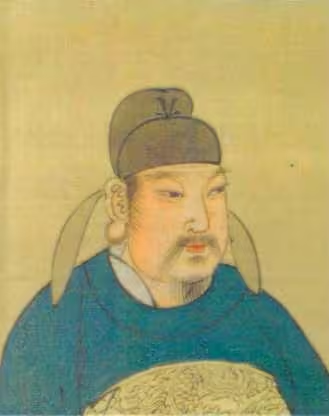
Li Yu 李豫
Reign: 762 - 779 (Guangde, Yongtai, Dali)
Daizong 代宗
Temple name
Emperor Ruiwen 睿文皇帝
Posthumous name
The Legacy
Emperor Daizong of Tang (9 January 726 – 23 May 779), personal name Li Yu, born Li Chu, was the eighth emperor of the Tang dynasty, reigning from 762 to 779. He was, by the roughest arithmetic, the emperor of the ruined third of the century: he presided over the end of the An Lushan rebellion, the Tibetan occupation of his capital, the defection of his greatest remaining general, and a collapse of the tax registers so complete that the Tongdian records fewer than two million households on the rolls by 760 against nearly nine million in 754.
Against that ledger, Daizong’s reputation is better than it should be. He ended the rebellion not with a final annihilating campaign but with a settlement — generous pardons, rebel generals confirmed in their commands — that traded justice for a decade of peace and permanently enthroned the warlord system in the northeast. He survived, successively, a eunuch dictator, a Tibetan army in Chang’an, and a general’s revolt, and he left the throne to his son intact. The Jiu Tang Shu praises a ruler who “endured humiliation and weighed the times” — the fairest available epitaph.
Reign & Achievements
Ending the war (762–763). On his accession in May 762, Daizong — who had commanded troops in person as a prince and understood armies — completed what Suzong’s generals had begun. With a second Uyghur alliance negotiated by the general Pugu Huai’en, the imperial and allied forces retook Luoyang in the autumn of 762; the rebel leader Shi Chaoyi fled north and hanged himself in the first month of 763, his severed head sent to the capital. The rebellion that had begun in 755 was over.
The great settlement. Daizong’s most consequential decision was restraint. Rather than prosecute the rebel officer corps, he confirmed An Lushan’s former commanders in Hebei — Tian Chengsi, Li Baochen, Li Huaixian — as military governors of their own armies. The arrangement, candidly described by later historians as “keeping the ringleaders as shepherds to stop the flock from scattering” (以贼制贼), ended the fighting at the price of creating the semi-independent Three Garrisons of Hebei, which would ignore taxes, appointments and edicts for the better part of a century. Peace bought at that price was still, by the standards of 763, peace.
Finance and logistics under collapse. With the equal-field and zu-yong-diao system dead in the war zones, Daizong’s government improvised a new fiscal spine: the state monopoly on salt, administered with genius by Liu Yan from 760, which by the 770s supplied more than half of central government revenue; the rebuilding of the Bian canal transport system linking the Yangzi rice surplus to the capital; and a cadastral survey that slowly re-registered the refugee population. These improvisations were the bridge between the old order and the Two-Tax reform of 780.
The western war. In 763, in the chaos of the rebellion’s end, a Tibetan army swept down through Longyou and occupied Chang’an for fifteen days, enthroning a puppet and forcing Daizong to flee to Shanzhou. The humiliation was brief but galvanizing: Guo Ziyi, left with a handful of men, bluffed, assembled and maneuvered until the invaders withdrew, and the frontier command of Guanzhong was rebuilt for defense. When Pugu Huai’en — the war-winning general slandered past endurance — led Uyghur and Tibetan armies against the throne in 763–765, Daizong’s diplomacy dismantled the coalition: Guo Ziyi’s celebrated ride, almost alone, into the Uyghur camp at Jingyang in 765, where he reminded the chiefs of their oaths and their pay, ended the invasion without a major battle. Pugu Huai’en died of illness on campaign in 765, his rebellion with him.
Cleansing the court. In 770 Daizong moved against the eunuch Yu Chao’en, the “army observer” whose power had survived the war; he was summoned and strangled on the spot. In 777 the chancellor Yuan Zai, corrupt beyond measure — his family wealth measured by the tens of millions — was arrested, interrogated and executed. The appointments of Yang Wan and Chang Gun that followed gave the late Dali years a brief reputation for austere, honest administration.
controversies & Failures
The price of the settlement. Every failure of late Tang central authority traces backward to the pardons of 763. Tian Chengsi of Weibo in particular ruled his prefectures as a private estate, waging private wars and assassinating a neighboring governor inside the imperial palace precincts in 775, answering only with apologies and gifts. Daizong’s response — patience, marriage alliances, gold — kept the north quiet and taught the northeast that the throne could be managed.
The Dali malaise. The last decade of the reign slid into the exhaustion historians call the Dali style: Buddhist establishments enriched by imperial favor, lavish court spending amid national austerity, and a bureaucracy that learned to survive rather than to govern. Daizong’s own devotion to Buddhism was famous — he honored the monk Bukong as a state preceptor — and the monasteries’ tax exemptions steadily eroded the very registers his ministers were trying to rebuild.
The Defining Trait: The Solvent Realist
Daizong’s defining trait was the refusal to confuse what was just with what was survivable. He pardoned men he knew deserved execution, honored generals he could not afford to punish, paid tribute he could not afford to refuse, and bought time against every enemy at once — Tibet, the Uyghurs, the Hebei warlords, his own eunuchs — with the same currency of pragmatism. The empire that his son inherited was poorer, meaner and safer than the one he had received.
Anecdotes & Folklore
- “Deaf and dumb make good parents-in-law.” The most beloved family story of the dynasty: in 767 the emperor’s daughter Princess Shengping quarreled with her husband Guo Ai — son of the great Guo Ziyi — who drunkenly boasted that his father had only “not bothered” to take the throne. The princess complained; the emperor replied with the immortal line: “You do not understand. He is right. If Guo Ziyi truly wanted the empire, it would not be our family’s.” When Guo Ziyi arrived to bind his son for execution, Daizong comforted him: “There is an old saying — to be a good father-in-law, one must be a little deaf and a little dumb.” The Zizhi Tongjian keeps both lines; the episode became the folktale “Beating the Golden Branch” (打金枝).
- The general and the empty city. When Tibetans held Chang’an in 763, Guo Ziyi — dismissed, elderly, with some twenty men — circulated rumors that imperial forces were massing from all sides and sent drummers to the city walls at night. The Tibetan general, measuring prudence against plunder, marched out within a fortnight. The tale of the empty ramparts became a byword for generalship of the nerve.
- The thirty-year funeral. Daizong’s beloved consort Dugu died in 775, and his grief produced a funeral so extravagant — the court suspending administration for days, the cortege so heavy the city walls had to be breached to pass it — that censors openly protested waste amid famine. The emperor’s answer, in effect, was that even an emperor may be extravagant once, about one person.
References & Historical Sources
- Jiu Tang Shu (旧唐书), juan 11 (Annals of Daizong).
- Xin Tang Shu (新唐书), juan 6.
- Zizhi Tongjian (资治通鉴), juan 222–226.
- Du You, Tongdian (通典), juan 7 — the household registers of the 760s.
- Denis Twitchett, Financial Administration under the T’ang Dynasty — on Liu Yan, the salt monopoly and the canal.
- Cambridge History of China, vol. 3, ch. on the restoration settlement after An Lushan.
- C. A. Peterson, “Court and Province in Mid- and Late T’ang,” in Cambridge History of China, vol. 3 — on the warlord system.