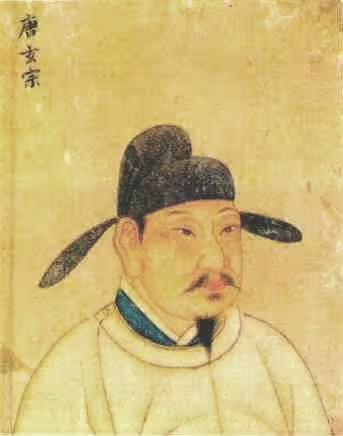
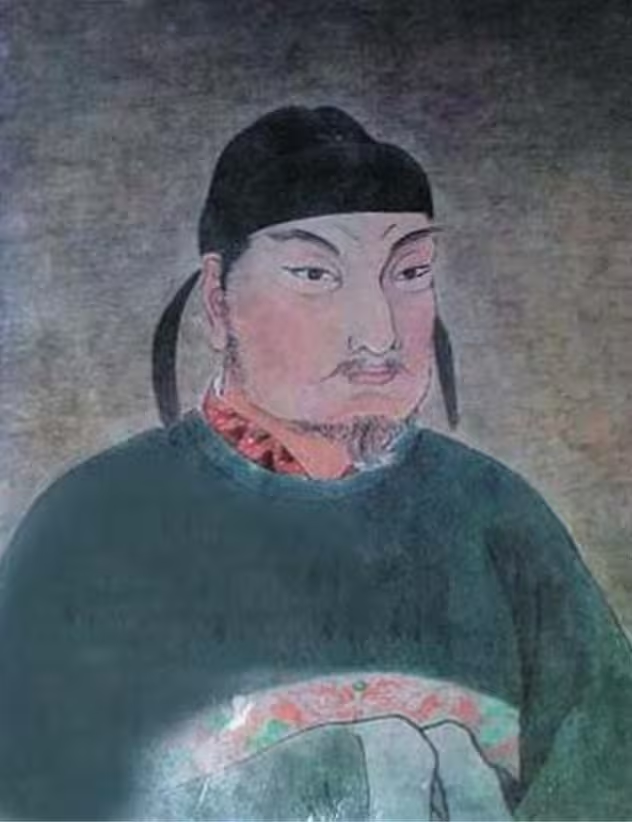
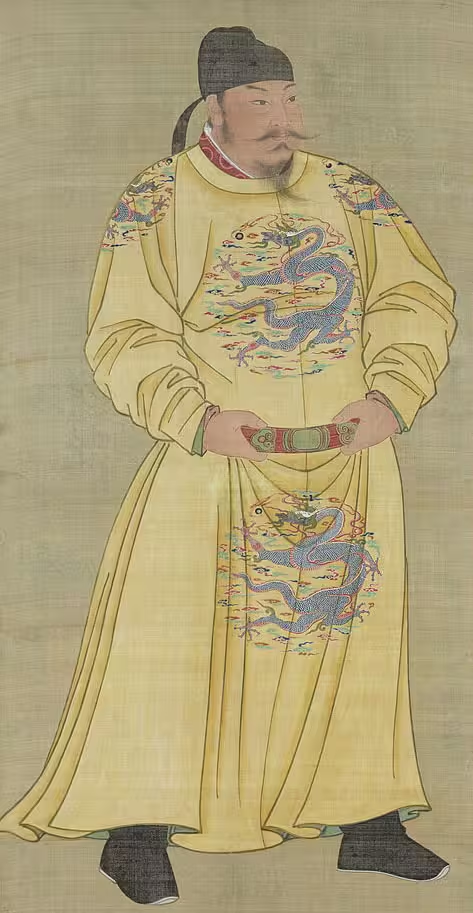
Personal Name:
Li Chen 李忱
Reign: 846 - 859 (Dazhong)
Xuanzong 宣宗
Temple name
Emperor Shengwu 圣武皇帝
Posthumous name
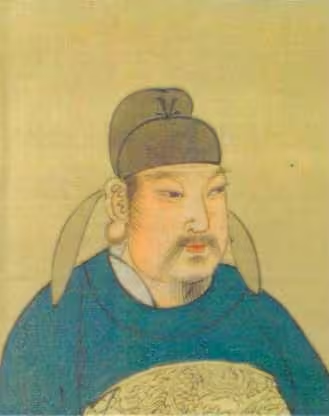
The Legacy
Emperor Xuanzong of Tang (27 July 810 – 7 September 859), personal name Li Chen, was the sixteenth emperor of the Tang dynasty and the last one for whom the word “restoration” has ever been seriously used. He was the thirteenth son of Xianzong, an uncle of Muzong, and the great-uncle of the three sons of Muzong who preceded him — Wenzong and Wuzong, who had spent twenty years at banquets treating this silent, awkward relative as the family fool. When the court met in February 840 to choose a successor for the dying Wuzong, the eunuchs picked the fool for a fool’s reasons: he would be safe, grateful and governable.
For thirteen years the joke ran the other way. The Zizhi Tongjian closes his annals with an assessment without parallel for a late Tang emperor: “Xuanzong was perceptive, resolute and deep; he applied the law without favoritism, followed remonstrance as readily as a stream, prized offices and rewards, was reverent, prudent and frugal, and cherishing toward the people — so that the governance of Dazhong, down to the very end of the Tang, was remembered and sung of by the people,” who called him, in awed comparison, “Little Taizong.”
What he could not fix he postponed. The eunuch establishment, the warlords, the fiscal rot — all of these he managed, contained, and handed on, along with the throne, to a son in whom every one of them flowered again.
Reign & Achievements
The long deception. The new emperor’s first act was the most eloquent: he dismissed the cabal of Daoist alchemists who had poisoned Wuzong, restored the proscribed examinations’ prestige, and began governing with an attention to detail his predecessors had reserved for games. The court discovered, weeks into the reign, that the “foolish Prince Guang” had been auditing them for thirty years from the cushions of the banquet hall.
The Dazhong administration. Xuanzong governed as Taizong’s deliberate imitator: personal interviews with every official he promoted, imperial copies of the Zhenguan Zhengyao distributed to his ministers, remonstrance rewarded rather than punished. His chancellors — Bai Minzhong, Linghu Tao, and the fearless Wei Mo, fifth-generation descendant of Taizong’s mirror Wei Zheng, whom the emperor prized precisely because he scolded — ran a court in which, for a decade, appointments went to capacity and the examination lists were read aloud before an emperor who remembered the names. Taxes were lightened, the registers rebuilt, the palace budget cut by his own example; the 848 famine response, in which remitted taxes and opened granaries followed the memorials within days, became the reign’s standard operating procedure.
The recovery of the northwest. Fortune and policy converged in the west. The Tibetan Empire, the dynasty’s enemy for two centuries, collapsed into civil war after the assassination of its anti-Buddhist emperor in 842; in 848, the Chinese gentry leader Zhang Yichao rose at Dunhuang and, one prefecture at a time, recovered the Hexi corridor in the Tang’s name. By 851 the eleven prefectures of the northwest had submitted their maps and registers — lands lost since the An Lushan rebellion, more than a century earlier, returned to the tax rolls under the reign historians call the Recovery of Hexi (河湟收复). It was the last territorial expansion of the Tang, and its only one in three hundred years not paid for by a generation of war.
The settlement of the south. He repaired the wound Wuzong’s persecution had torn: temples were quietly rebuilt within regulated limits, the Buddhist establishment re-registered and taxed rather than annihilated, and the age’s greatest poet, Bai Juyi, was mourned at court with an imperial elegy — a small act of cultural repair that symbolized the reign’s temper.
controversies & Failures
The revenge on Huichang. Xuanzong’s first years undid his predecessor’s work with the same thoroughness Wuzong had shown in making it: Li Deyu, the great chancellor of the Huichang restoration, was demoted through a series of ever-southern prefectures to Hainan, where he died in 850; the Niu faction’s exiles returned. Whatever the factional justice of it, the dynasty lost its last great administrator to the politics of succession.
The succession he failed to settle. The emperor’s favorite was his brilliant third son, the Prince of Kui, and the court knew it; but the eldest son, Prince Wen’s eldest boy Li Cui, held the formal line. On his deathbed in September 859 the emperor could not finish the choice — and the eunuch Wang Zongshi settled it in a night, installing Li Cui as Yizong. The boy was fourteen; within fifteen years the dynasty was ash.
The Defining Trait: The Hidden Dragon
Xuanzong’s defining trait was concealment in the service of survival — and then, astonishingly, in the service of government. For thirty years he had worn the mask of simplicity while uncles and cousins drank and joked around him; for thirteen years he wore the mask of Taizong, quietly and competently, while the empire around him continued its descent. Both masks were perfect. Only one of them was a mask.
Anecdotes & Folklore
- The fool at the banquet. The court’s memory of Prince Guang was fixed: he sat silent through Wenzong’s jokes and Wuzong’s baiting, and once, by one account, was sent sprawling from a bolting horse in the snow and lay laughing until helped up — “the Fool is well again!” Wuzong roared. Thirty years of such moments purchased the thirty months of power that followed; the eunuchs who enthroned him in 840 were congratulating themselves on the dullest emperor in living memory when the edicts began to issue, in a hand and a mind nobody had seen before.
- The emperor’s own examinations. Xuanzong interviewed officials as Taizong had, and once — by the court’s gleeful retelling — found a candidate’s dossier inflated with ghost-written verse; he read the man the poem, then read him his own examination essay, and promoted the essayist and failed the poet. The story, preserved in Tang notebook literature, may be polished; the archive of Dazhong appointments suggests the policy was real.
- The princess and the broken rule. His daughter, Princess Wanshou, married the scholar Zheng Hao, whom the chancellor had snatched mid-betrothal from a Lu family girl to make the match. When the princess failed to attend her sick brother-in-law, the emperor summoned her and, in the Tongjian’s account, reminded her to her face of the family’s rules of decorum before the whole court — the father correcting the daughter in public, as he said, “so that the princesses of this house may know what is owed.” Later Tang princesses, who never knew his reign, did not enjoy the comparison.
- The elegy for Bai Juyi. When Bai Juyi died in 846, just after the new reign began, the emperor asked Bai Minzhong whether he was kin to the poet, learned he had died, and fell silent. The elegy he sent the family — “Sixty years strung pearls and linked jade; who would carry on the poetry of our house?” — is one of the few imperial poems of the late Tang still anthologized.
- The white horse. The eunuch Ma Yuanzhi, who had made him emperor, once presented Chancellor Bai Minzhong with a white horse; the censors pounced, and the horse became a parable about the eunuchs’ gifts. The emperor’s solution was characteristic: he accepted the censors’ point, declined the eunuch’s sulk, and kept both men in their places for years — managing the palace as his nephew Wuzong had never managed anything but enemies.
References & Historical Sources (文献来源)
- Jiu Tang Shu (旧唐书), juan 18 (Annals of Xuanzong).
- Xin Tang Shu (新唐书), juan 8.
- Zizhi Tongjian (资治通鉴), juan 248–249 (the Dazhong years; the closing assessment of 859).
- Cefu Yuangui (册府元龟), relevant juan — Dazhong-era documents and appointments.
- Cambridge History of China, vol. 3, ch. on the late ninth century.
- 岑仲勉 (Cen Zhongmian), 隋唐史 — on the Dazhong restoration and the Hexi recovery.
- Christopher Beckwith, The Tibetan Empire in Central Asia — the Tibetan collapse that made 848 possible.